The originator of the slow-reading barbecue may be Yuanmou.
These days,
The topic of barbecue in Zibo can be described as a fire.
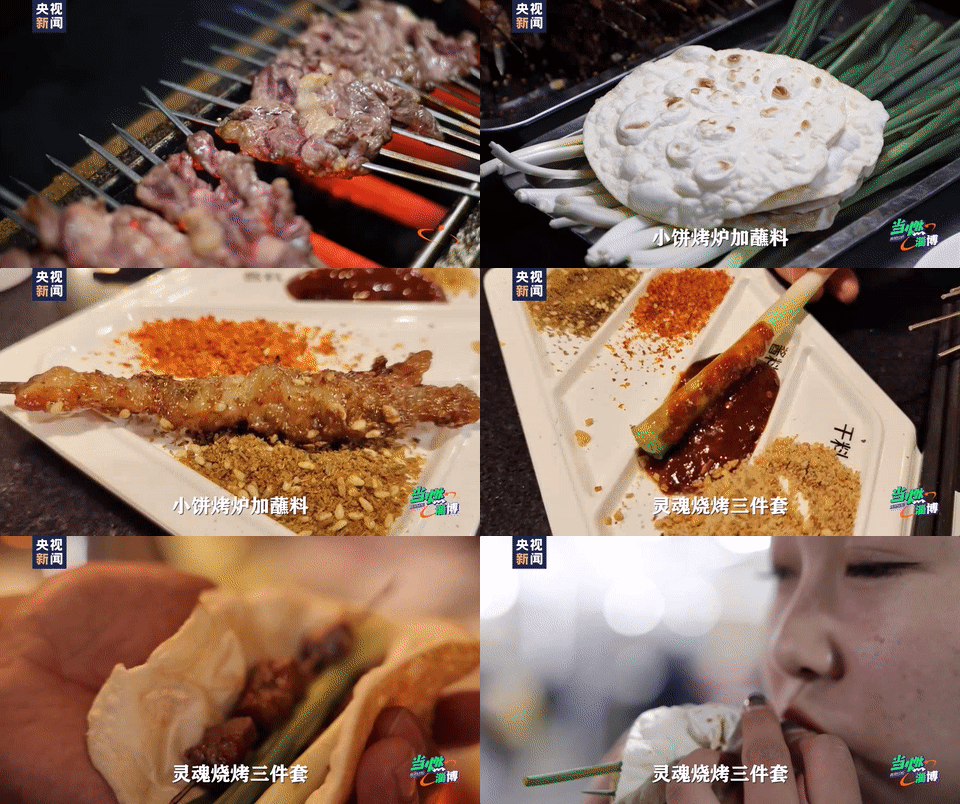
Three-piece barbecue set of "oven, cookies and dip"
Become the hottest topic in the current food circle.
But then again,
The history of the ancients eating barbecue.
Absolutely beyond the imagination of ordinary people
Whether it is a variety of archaeological relics
Or rich written records.
The fireworks in history can’t be covered if you want.
Let’s follow the ancients to "get together"
Have a cultural barbecue tour.
The origin of barbecue begins with fire.
As for the symbol of the emergence of human civilization, some people say that it is the creation of words, some people say that it is the invention of tools, and some people say that the appearance of fire has brought mankind out of the age of ignorance, which has since opened the prelude of human civilization. For foodies, words and tools may not be so important, but fire is crucial. The reason is simple: without fire, there is no food.
It is speculated that the earliest hominid who used fire in the world may be China’s mastermind. Assuming that Yuanmou cooked the prey for the first time on behalf of human beings, the barbecue should have a history of 1.7 million years. As you can imagine, a handful of branches and a fire can turn fishy raw meat into a fragrant barbecue, which is undoubtedly revolutionary for ancient humans. Theoretically speaking, processing food with fire can make people eat cooked food, which not only improves the delicacy of food, but also protects teeth and greatly reduces the occurrence of diseases, which is undoubtedly very significant for the improvement of human physical quality and intelligence.
Archaeologists found many animal bones left over from barbecue in Paleolithic sites. For example, 600,000 years ago, Peking Man in Zhoukoudian, Beijing, had traces of barbecue, and 300,000 years ago, relics of ancient human picnics were also found in Xiangfen Ding Cun site group. In the Neolithic sites, archaeologists even found the used barbecue grill. For example, in the Majiabang cultural site in Jiaxing, Zhejiang Province, 7,000 years ago, a long ceramic barbecue grill was unearthed. This red ceramic grate with sand has one ear at each end, which is quite similar to today’s barbecue grill and can be called the "originator" of the barbecue grill. Six thousand years ago, two pottery grates were also unearthed at the Chiwan Dune Site in Guangdong Province, which are the evidence of ancient barbecue food.
In the ancient legend of China, Fuxi, the ancestor of China, bravely took fire from heaven and made people eat cooked food. For this reason, later generations called Fuxi "Yong Sacrifice", that is, the first person who cooked animal meat with fire. Another ancestor, "Sui Ren Shi", taught people to drill for fire, which made the application of fire more convenient.
Interestingly, although "barbecue" has a history of millions of years, the word "barbecue" appeared very late. In Kangxi Dictionary and Shuowen Jiezi, the word "Kao" has never appeared. Previously, the ancients generally called "barbecue" as "broiling", such as "broiling" in the Book of Rites, that is, skewering the meat and roasting it on the fire; Another example is the explanation of "roasting" in Shuo Wen Jie Zi: "Canned meat is also", that is, barbecue. Look from the glyph, "broil" is a knowing word, and the meaning of "meat" and "fire" is very clear.
When it comes to the word "roast", most people will think of the idiom "popular", which comes from Mencius with all my heart. The original meaning is that everyone loves to eat finely roasted meat, and it is later used to describe poems or things that are loved and praised, showing the popularity of barbecue at that time. In addition, there is a sentence in Xin Qiji’s noun "Broken Array", "When you are drunk, you will see the sword, and you will dream of blowing the horn." Eight hundred miles under the command of the main, fifty strings turned over the Great Wall, the battlefield autumn soldiers. " The "roast" here also means barbecue.
So, where did the word "baked" come from? According to the introduction in the article "Kao" in Deng Tuo’s Yanshan Night Talk, the word "Kao" was newly coined by Mr. Qi Baishi when he inscribed the signboard of "Barbecued Meat Garden", and the master also added a line of small characters under the title: "There is no word" Kao "in all the books, so at the request of people, I am dead."
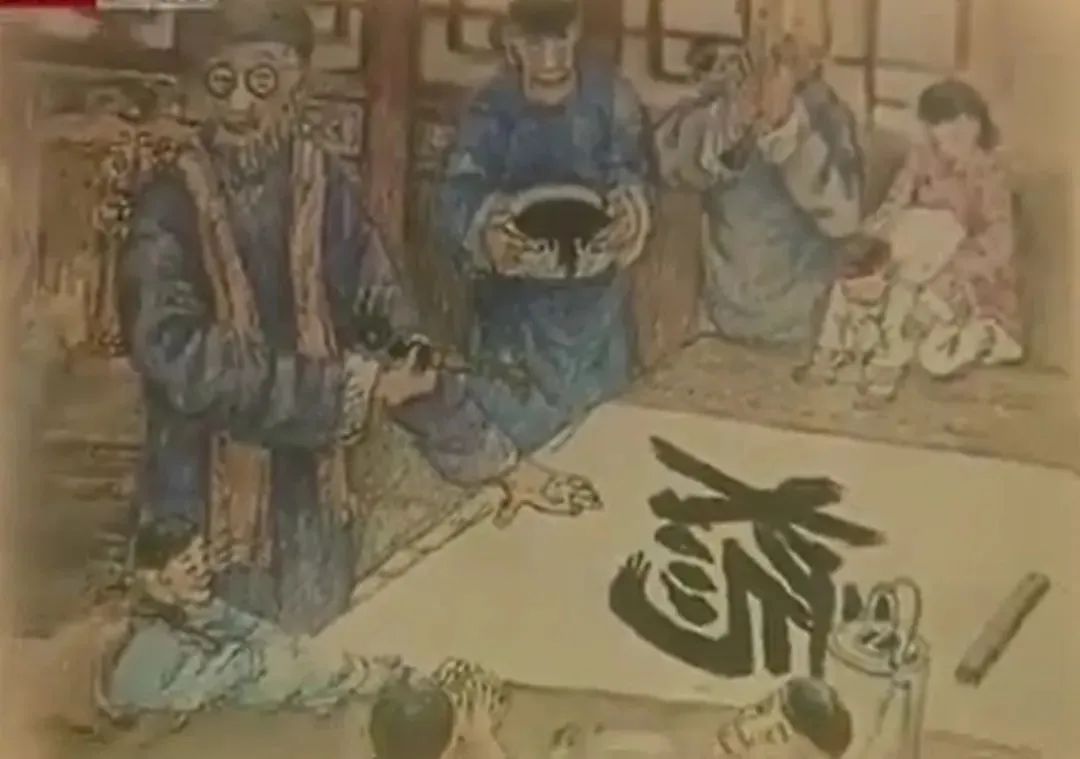
Qi Baishi wrote an inscription. Source/Beijing Satellite TV "Happy Life" screenshot
Barbecues in different dynasties have their own characteristics.
After the pre-Qin period, there were three main barbecue techniques: burning, firing and roasting. For example, it is recorded in the Book of Rites: "The former king … ate the real things of plants, the meat of birds and animals … burned them with guns and cooked them with fire." These four cooking techniques, except frying "cooking", three of them are barbecue. The so-called "burnt" means directly roasting the meat on the fire; "Cannon" is to wrap the meat with grass or mud and bake it, similar to the current "beggar chicken"; "Roasting" is to cut the meat into small pieces and skewer it, which is the earliest "skewer". In the Book of Songs Xiaoya Xuan Ye, it is even recorded that "one rabbit is roasted three times": "There is a rabbit’s head, and the cannon is burnt … there is a rabbit’s head, and it is burnt … there is a rabbit’s head, and the cannon is burnt …"
In the Qin and Han Dynasties, barbecue was still popular. According to Liu Xin’s Miscellaneous Notes on Xijing, after Liu Bang, Emperor Gaozu, ascended the throne, "he often barbecued the liver of deer and drank wine", and Emperor Zhao even held a "barbecue festival". The son of heaven loves it, and the ministers certainly like it. Similar barbecue pictures are common in the stone carvings of Han Dynasty portraits, such as the Kitchen Picture unearthed from Sun Yan’s tomb in Zhucheng, Shandong Province, which not only depicts the chef, knife worker, fireman and other figures, but also shows the processes of cutting meat, handing meat, wearing kebabs, sending kebabs, fanning kebabs and loading plates, which can be described in an orderly and meticulous manner. In addition, many barbecue utensils and objects were found in Han tombs such as Mawangdui in Hunan, including bamboo skewers, copper ovens and even iron ovens still wearing the remains of cattle, sheep and pigs.
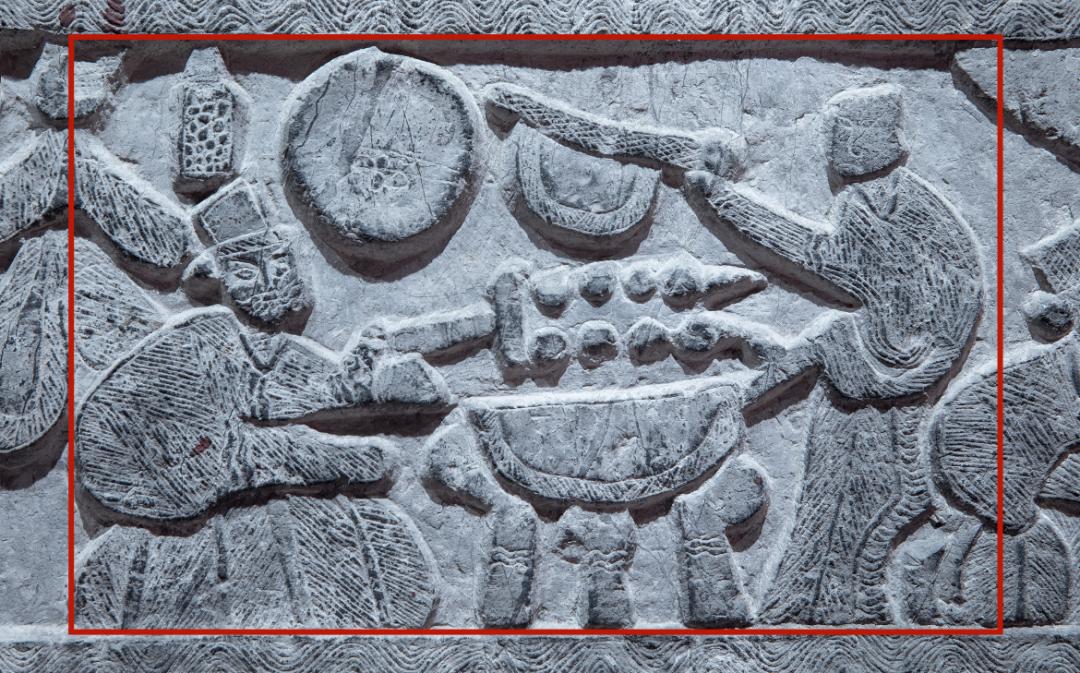
△ Linyi Wulibao Han stone relief-"Kitchen Map", there is also a picture of two people barbecuing, one of them barbecuing and the other holding a fan.
During the Sui and Tang Dynasties, because of the great influence of Hu Feng, barbecue not only occupied an important position, but also had more varieties. At that time, in addition to the common cattle, sheep and pork, people recorded the roast of wild boar, mandarin duck, clam, mussel, bright shrimp and so on. Among them, the most famous one is probably the so-called "hump roasting", which was spread from the western regions to the Central Plains. There is a record in "Youyang Zayu" that "the general Qu Lianghan can roast the donkey’s mane hump, which is delicious".
The Song Dynasty was an era of delicious food, and barbecue food was more diverse. According to "Miscellanies of Years Old", barbecue has become the daily life of Song people in winter. Many people put a grill on the stove at the same time to make the best use of it. In this way, the family sat around the fireside to warm wine and barbecue, which was very enjoyable. In the notes such as Dream of Liang and Dream of Hua in Tokyo, dozens of barbecue foods are recorded, such as roasted rabbits, roast duck, and "spin-roasted pork skin", which are all common things in Kaifeng night market. Another example is Su Dongpo’s poem "Play Answers to Fo Yin", which says that "the distant public sells wine and drinks Tao Qian, while Fo Yin cooks pigs and waits for the children to look forward to it", which is about roast suckling pigs.
Because the Yuan Dynasty was a nomadic regime, sheep barbecues were the most common. At that time, in addition to roast mutton, new varieties such as roast lamb loin and roast lamb heart were developed. By the Ming and Qing Dynasties, barbecue food was more popular. For example, in the famous Dream of Red Mansions, there is a description of "the world of colored glaze is full of white snow and red plums, and the baby with fragrant powder cuts the fishy smell", and what is written here is the big scene of barbecuing venison in the Grand View Garden. In addition, the Manchu-Han banquet at that time was actually the common name of "barbecue mat", among which hanging pheasant, raw roasted meat, sliced suckling pig, hemp-kernel venison skewer, imperial roast chicken and roasted deer breast were all barbecue dishes. Rich people love barbecues, and so do the people. At that time, vendors selling barbecues and skewers were everywhere in the streets, showing how popular barbecues were.
Modern barbecue, four schools
The ancients loved to eat barbecue, and modern people are not inferior. According to the analysis of a willing heart, the current barbecue Jianghu is mainly divided into four schools, and within the four schools, there are small branches with their own characteristics.
First of all, I want to talk about the northeast school. The northeast here is literal, not the three northeastern provinces. Three of the representatives are Zibo Barbecue, Qiqihar Barbecue and Jinzhou Barbecue. Zibo BBQ features self-help cookies, and there is a small stove on each table. The kebab chef cooks kebabs, chicken wings, fish fillets, etc. on the big stove until they are half-cooked, and then lets customers cook the half-cooked kebabs themselves until they are fully cooked. As for the cookies, they are also the soul of barbecue in Zibo. The way to eat them is to clamp the baked kebabs, then remove the labels, and put some shallots, Chili sauce or sesame salt, peanuts, etc. When you go down, your mouth is full of happiness.
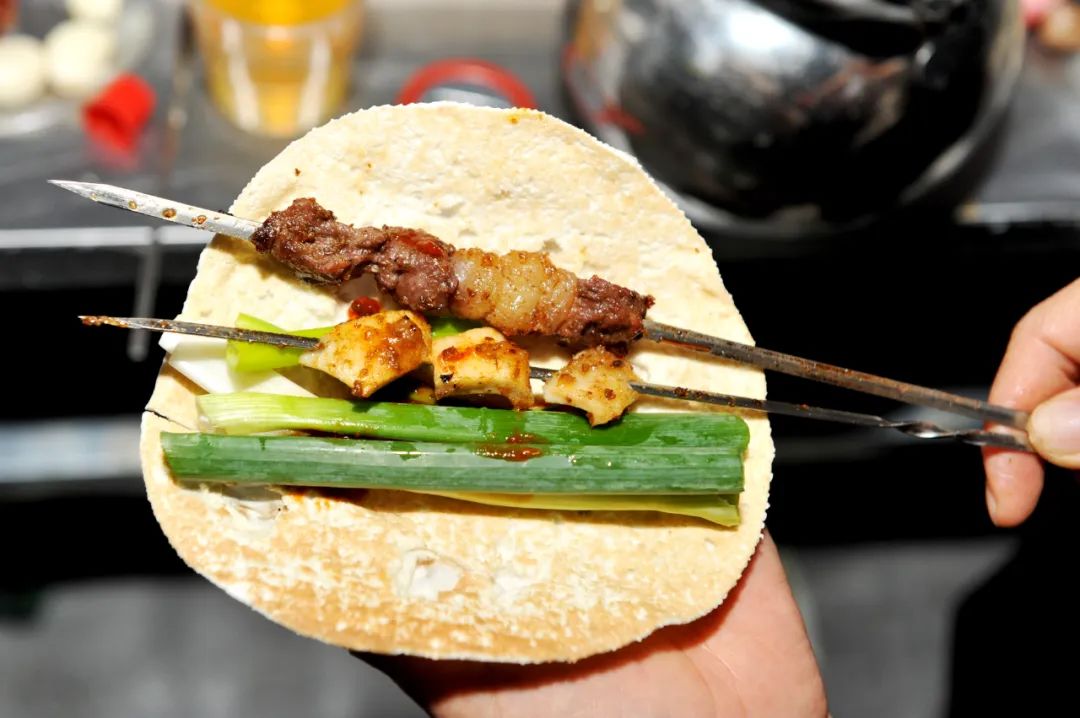
Zibo BBQ iconic food. (Xinhua News Agency issued by Liu Yiming)
In Qiqihar, most people bring their own baking pans at home. The pot is divided into two parts, the bottom is a stove for holding charcoal fire, and the top is an iron cover with eyes, on which the meat is roasted. The characteristic of Qiqihar barbecue is that different seasonings are added in each family, which creates a variety of flavors.
The characteristic of Jinzhou barbecue is that "everything can be roasted in one furnace", such as chicken feet, drumsticks, chicken heads, chicken hearts, chicken gizzards, chicken crisp bones, pigeons, quails, silkworm chrysalis, grasshoppers, leeks, eggplant, baby vegetables, Flammulina velutipes, dried bean curd, all kinds of seafood, etc., and mutton kebabs are no longer the absolute protagonists of barbecue.
Among the northeast schools, Jinan and Qingdao are also quite distinctive. Jinan was once a "string capital", and the night market was full of small mazar, small square tables and small ovens, and the cool draft beer was the greatest enjoyment. The standard of Qingdao barbecue is barbecue with wild wonton. The barbecue is mainly roast pork, and seafood is a major local feature.
Next, the northwest schools, including Xinjiang, Ningxia, Gansu, Shaanxi, Inner Mongolia and other places, are mainly authentic mutton, so they are also considered to be the most authentic barbecue. Someone once said, "If you haven’t been to Xinjiang, don’t say you have eaten mutton kebabs." Roasted mutton in Xinjiang, the sheep were slaughtered on the same day, and the skewers were red willow branches. The kebabs roasted were delicious, tender outside, fresh and juicy, and the taste was memorable. The kebabs barbecued in Ningxia pay attention to "three thinness and one fat" and must have fat meat, but they are fat but not greasy. In addition to mutton skewers, the roast lamb’s hoof and waist of the northwest school are also a must.
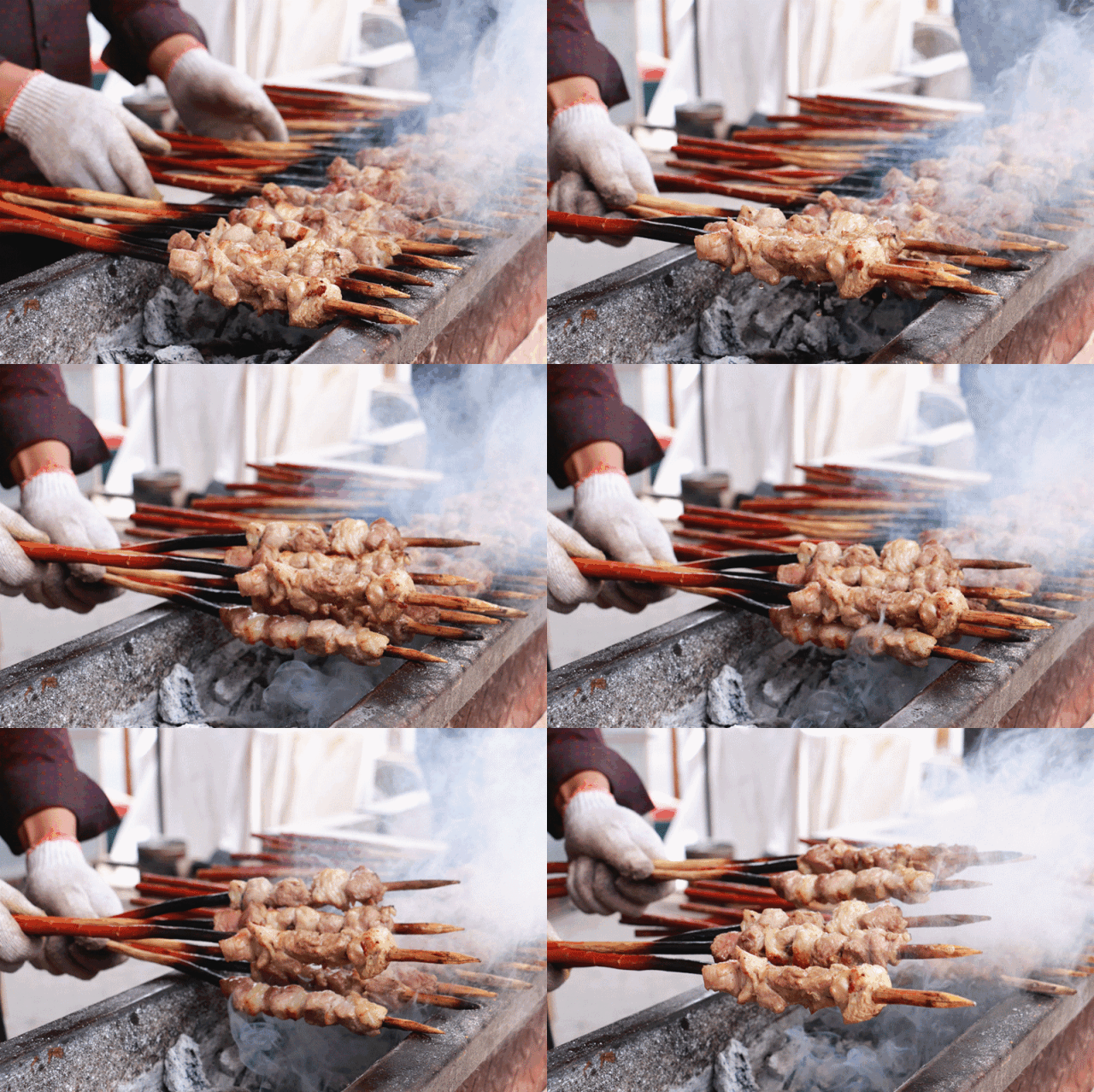
Xinjiang roasted mutton.
The third thing I want to talk about is the southwest school, among which the representatives are Sichuan barbecue and Yunnan barbecue. The characteristics of Sichuan barbecue are small skewers, selling on the handle, and stressing spicy and dry incense. Because the string is small, the requirements for the barbecue chef are high, and it is necessary to roast with a big fire to accurately grasp the heat. As for Yunnan barbecue, it is mainly characterized by rich dipping materials and ingredients. Among them, dipping materials are divided into dry materials and wet materials, such as sufu dipping in water is more representative. In Yunnan, there are not only "everything can be roasted", but also some special ingredients similar to dark dishes, such as pork nose tendons, chicken foot tendons, pig gums and even bamboo worms, grasshoppers, water dragonflies and various wild mushrooms. Eating a Yunnan barbecue will definitely subvert the cognition of barbecue.
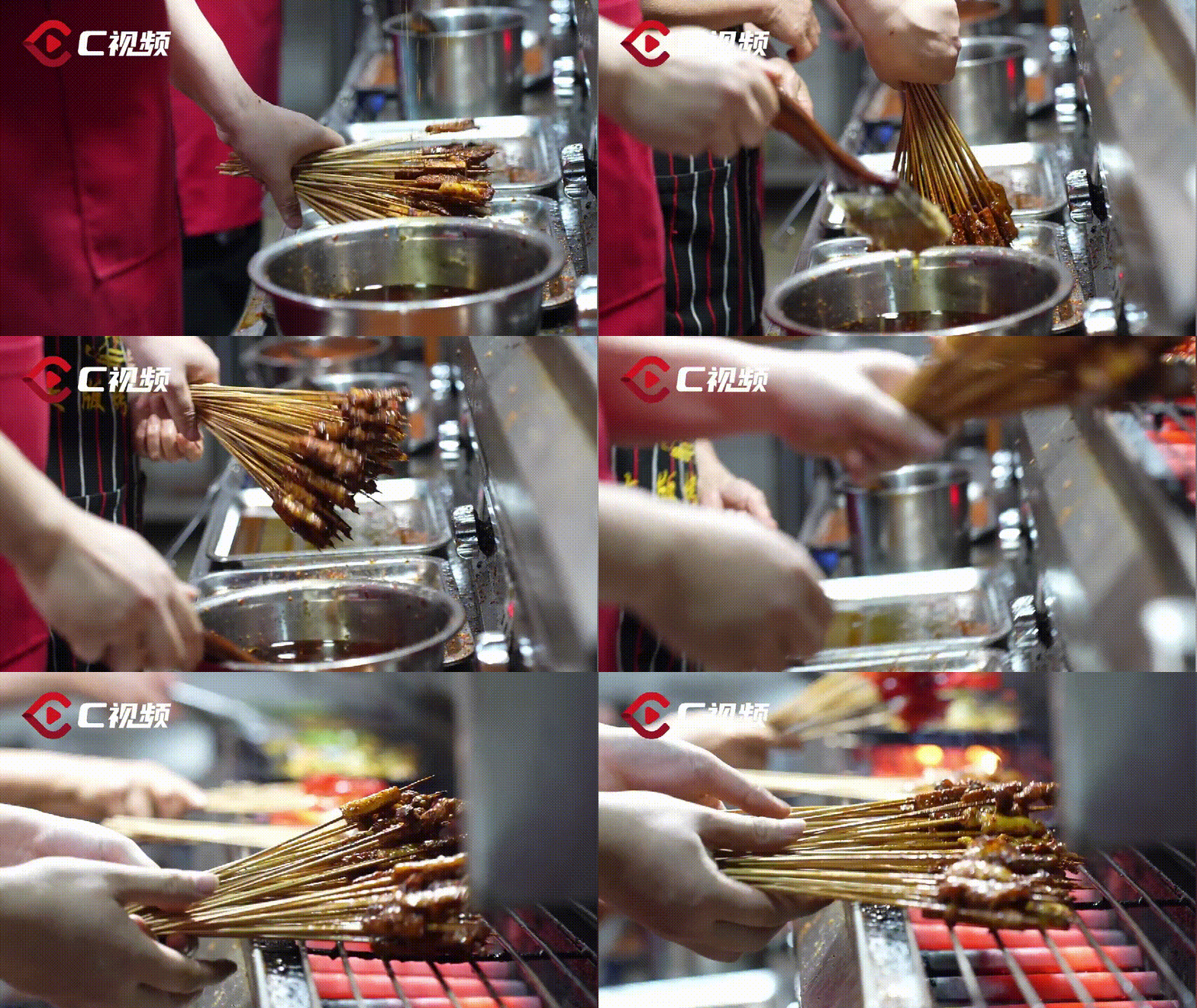
"Burn the handle" in Yibin, Sichuan.
The last one is the southeast school, among which Guangdong barbecue and Hainan barbecue are the representatives. The common feature of barbecues in these two places is that the main characters are seafood. As the saying goes, relying on mountains to eat, relying on the sea to eat, roasting oysters, squid, sand worms, shrimp and conch, together with garlic dipping, invisibly gives barbecue a new soul.
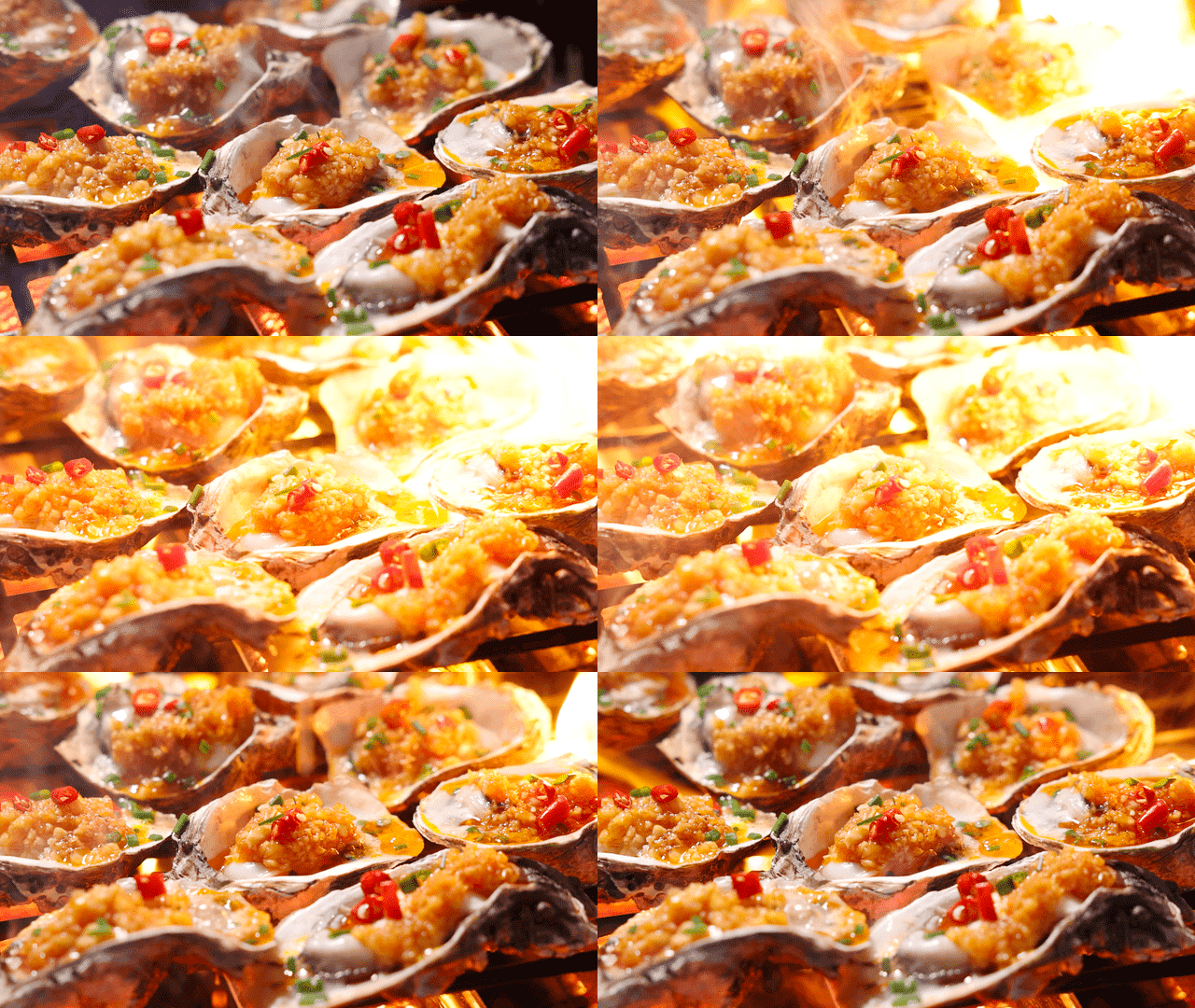
Grilled oysters.
Generally speaking, barbecue is a traditional food in China, with different ingredients and styles, so it is difficult to generalize. It is shallow to read on paper, and only when you are there and taste it yourself can you really appreciate the flavor.
"May Day" holiday
Did you "string"?
Share it with the daily girl ~
Original title:
Gourmet on the flame
Gu Jin tong ai Lu yi chuan
Source: Hainan Daily Hainan Weekly
Contributed by Jin Manlou.
Image source: CCTV News WeChat WeChat official account, Xinhua News Agency WeChat WeChat official account, Hainan released WeChat WeChat official account, Xinjiang Daily WeChat WeChat official account, Sichuan Daily WeChat WeChat official account, National Humanities and History WeChat WeChat official account, etc.
Duty Officer: Rong Hai
Duty supervisor: Liu Jiji
Original title: "The originator of slow-reading barbecues may be the Yuanmou people"
Read the original text