This spring
Teachers in a special way
Meet cufer "in the cloud"
Massive open online course, Quick Class, WeChat Small Class
Synchronous class, online discussion and online answering questions
The epidemic is in the forefront, and research is not limited.
1430 undergraduate courses
2,222 classes
Teachers rely on curriculum content and requirements.
try one’s very best
Create a "three-foot cloud platform"
Carry out teaching work for 91,959 undergraduate students.
"Network Teaching Challenge" officially opened
Homemakers engage in academics.
The epidemic situation keeps learning
Cufer exclusive "micro-classroom"
Continuously updated!
Today xiaobian introduces you
"Academic research articles"
Teach you how to engage in academics!
How to write undergraduate graduation thesis?
Worried about the thesis near graduation?
Don’t worry!
Teachers of our School of Finance and Economics focus on students’ needs
Create a "personal tailor" micro-classroom
Teacher Yu Jian’s thesis writing instruction class is coming!
Writing and Guidance of Undergraduate Graduation Thesis
Speaker: Yu Jian
Ph.D. in Economics, Renmin University of China, currently serving as an associate professor and tutor of master students in School of Economics.
//
brief Introduction of the content
//
In this WeChat class, Mr. Yu Jian gave guidance to the writing of undergraduate graduation thesis, mainly from the following aspects.
First of all, Mr. Yu Jian provided a variety of options for the topic selection materials and ways of graduation thesis. He suggested that students should study topics with China characteristics from current hot issues, classical theoretical issues and issues of interest to them. When the theme of the paper is decided, everyone should start to find high-quality academic literature. Teacher Yu Jian summed up several characteristics of high-quality literature, namely, standardized economic analysis, high-grade journals published, many articles cited, and original and groundbreaking research issues. You can screen out high-quality papers for reference through these four characteristics.
Next, we should think about how to refine the innovation of the article. Teacher Yu Jian pointed out that some students think that as long as they study problems that others have not studied, it is innovation, which is a misunderstanding of thinking. The real innovation can be new research data, the application of old methods in new fields, a new research perspective and a new analysis of transmission mechanism. In addition, the current economic research is inseparable from the support of data. Teacher Yu Jian classified this according to the characteristics of data, and recommended relevant query sources for macro data and micro data.
When these preliminary works are completed, everyone is faced with the problem of writing a literature review. We need to pay attention to the five principles of writing literature review, namely, quoting classics, avoiding piling up documents, not sticking to details, grasping key points, and increasing literature context and comments. Teacher Yu Jian introduced them in detail. Finally, Mr. Yu Jian raised the question of the choice of research methods and sorted out three methods for everyone to choose.
The above is the main content of this WeChat class. I hope students can gain knowledge about paper writing, enrich themselves, enrich themselves and improve their academic research ability.
Teach you to stay at home and do academic work!
The tutor prescribed a good prescription, and the house kept researching.
My finance graduate school was launched in WeChat official account.
"Teach you how to stay at home and engage in academics" column
A series of WeChat small classes for you.
Share experiences and give directions.
Let knowledge transfer and value lead the same frequency resonance!
one
Special period, forging special you
Speaker: Chen Yunsen
Professor of Accounting College, doctoral supervisor, Longma scholar-young scholar. Dr. Tsinghua University, a visiting scholar at Washington University in St. Louis and Chinese University of Hong Kong, was selected as the national accounting leading (reserve) talent program of the Ministry of Finance.
Special period, forging special you
Chen yunsen
A sudden COVID-19 epidemic has disrupted the pace of work and study for each of us.
No matter who you are, no matter what you are doing, you are always paying attention to the epidemic situation and being closely touched by this arduous epidemic prevention war.
Real-time data of epidemic situation disclosed by official media, rumors and rumors spread rapidly by social media, and whether there are infection cases in surrounding communities are all coming. The complexity of epidemic situation, the overload of information and the imbalance of mentality all make Chinese people anxious under the haze.
For our graduate students, this state of anxiety is especially serious in the face of the degree thesis to be submitted soon, the long-unfinished scientific research project or the sharp decline in learning efficiency.
What I want to say is that in a special period, forge a special you. Let’s "blame and upgrade" together on a special day. Here are a few Tips waiting for your Pick!
01. Temper your strong will and shape your sunshine mentality.
At present, people all over the country are forced to press the pause button. As time goes by, the incident has had a more or less impact on every student, and the students who are unfortunately in the areas with serious epidemic or whose family and friends are affected by the epidemic, as well as the graduating students who are in the critical period of their dissertations and employment.
However, everything has two sides. We have lost a lot from the "home life", but we can also get a lot. The biggest benefit is that we have a lot of rare time that can be controlled by ourselves. Guo Guangchang, the founder of Fosun, mentioned in a speech at Chaos University: "Are we willing to slow down and do something slow? Sink down, do the right thing, do the difficult thing, invest in the future, and do things that take time to accumulate. "
The greatest wealth in life is to have free time. For everyone, now is a good opportunity to settle down and think, study, settle down and examine yourself in silence, make a good position for your future, and do some solid work for your upcoming academic studies. Give your time a little time and give your hope a little hope.
Recently, I have been rereading Wang Yangming, especially his experience of realizing Taoism in Longchang, and I have a lot of feelings. The more difficult it is, the more time it takes to cultivate my mind. Great things are difficult, look at the responsibility, adversity is prosperous, and look at the mind. Since external objective factors cannot be changed, we should face them optimistically and calmly, and at the same time take this as a good opportunity to temper our will and actively find ways to deal with it. At home, teachers are constantly struggling with their own inertia and trying to maintain a fiery passion in a poor scientific research environment. I hope that graduate students will sort out their mentality and devote themselves to scientific research. By the end of the epidemic, they will be able to go more steadily and lofty.
02. Effectively divide tasks and arrange the schedule reasonably.
When the deadline for dissertation or scientific research project is clear, my general method is to push forward from the "deadline" and make clear what should be done at each time point and step. In the process of applying the "push method before the deadline", you need to leave yourself a buffer time of 1-2 days and a buffer time of 3-5 days for your tutor. For example, the school requires to hand in the first draft of the dissertation on March 15th, so the tutor must be given a full version of the dissertation on March 5th (the tutor’s schedule is very tight, so it is necessary to reserve time for sending it to him immediately), while on March 1st, he must finish the first draft of the dissertation himself (so that he can have time to polish and modify it as a whole and avoid various problems). To achieve this timeline, it means that all research forms and institutional backgrounds must be perfected on February 25th …
There is a classic line in Looking Up, "Life is like archery, and dreams are like an arrow target. If there is no arrow target, your daily bow drawing is meaningless". The same is true for scientific research. If you want to make good use of this method, you must divide the scientific research tasks effectively and reasonably, and find your own arrow target at every time node, instead of "grabbing your beard and eyebrows" every day, so that you are always in an extremely anxious and inefficient state and fall into a vicious circle.
03. Plan the daily timeline and create a sense of scientific research ceremony.
Academic research needs state. I have summed up my "state change curve" in one day. Generally speaking, the scientific research ideas are most active from 4 pm to 6 pm and from 10 pm to 1 am, while the state in the morning is average.
Therefore, my schedule for the day is: doing some routine and trivial work in the morning, such as downloading documents, regularly sorting out data, sorting out some institutional backgrounds involved in academic papers, etc. In the afternoon and evening at the peak of scientific research, the mobile phone and computer are basically disconnected from the internet (or deliberately away from the mobile phone and computer, and less online), and then focus on overcoming the non-programmed things in academic research that take a long time to do. You can also try to find your own "state change curve", and then arrange the time of the day reasonably and do the right thing at the right time.
In addition, the research environment at home is not as good as that at school, so some "special means" are needed to cut off all kinds of "temptation sources". You can set up your own workspace in advance, preferably an isolated space, with only necessary items on the table and clear away things that are easy to distract you in the line of sight. Every morning, when you want to force yourself into scientific research, first make a pot of tea or a cup of coffee, then put on headphones, randomly play some light music or white noise that can make the environment seem quieter, and then say to yourself, "Hey, it’s time for you to start working!
Creating a "sense of ceremony" is actually giving yourself a strong psychological hint. You will find that when you are used to such a "sense of ceremony", whenever you want to start learning, you no longer need to look for an illusory state, but just enter the workspace, and you will follow your own rules in a reflexive way and naturally enter the best state.
04. Supervising and motivating together, internal and external constraints.
If your self-control is not so strong, you may need to establish a reasonable and effective supervision and incentive mechanism to restrain and motivate yourself to the maximum extent. There is a good saying: "There are two indispensable partners in completing important tasks: one is planning, and the other is not enough time."
You can list the scientific research plan that has been effectively divided on paper, clearly mark the deadline of each task, place it in an easy-to-see area in the work area, remind yourself of the urgency of time and the importance of the task at any time, and give yourself an active supervision psychologically.
At the same time, you can also rely on external forces. For example, there are many APPs that learn to punch in, such as Forest and tomato To Do. You can choose an app that suits you and set the corresponding time for yourself, or you can make an agreement with your friends to work at the same time every day, plant a tree with Forest and supervise each other. No matter which method is adopted, you need to set the corresponding conditions and measures of punishment and incentive in advance, and remember to punish yourself if it is not completed! If you have finished, give yourself a reward and affirm your efforts. This sense of celebration ceremony will produce positive feedback and make your self-discipline have a positive cycle. However, we should also pay attention to the form of rewards. For example, playing mobile phones should not be used as a reward after completing a short period of study, because it will make it difficult for you to quickly enter the next stage of work. In addition, you can also actively contact your tutor, report your phased research results to your tutor regularly, and inform your tutor of the next research arrangement, thus giving yourself an external pressure.
People’s self-control is limited. As described in "Great Failure", many talented entrepreneurs are finally defeated by the word "desire". Pythagoras also said, "He who cannot restrain himself cannot be called a free man". After all, external forces are only auxiliary. Overcoming one’s own inertia, reducing one’s colorful desires, and doing subtraction for oneself, Focus on Focus, are the keys to enhancing self-control.
05. Cultivate business sensitivity and enhance social empathy.
The suddenness, unpredictability and great uncertainty of the epidemic have great influence on enterprise management, capital market investment and macro-economy. During this period, the frequent introduction of various national policies, the analysis reports of media analysts, the self-help of enterprises and entrepreneurs, and the professional analysis of scholars and think tanks have provided us with a good scene to test various events.
As a financial background, we have learned a lot of business management, macroeconomics, capital market and other related professional knowledge, but we have been lacking in practical baptism, and we have no idea that this matter should be put into practice. Students can just use this scene of the epidemic to understand the actual impact of an exogenous shock on macroeconomic and microeconomic subjects’ behavior and ask themselves what we can see from the economy and people’s livelihood under the new crown epidemic when the "black swan" flies. This is a good opportunity to improve financial literacy and cultivate Business Sense in the capital market.
In the drastic changes, it is easiest to see people’s nature and self-cultivation. Students should observe the life under the impact of the epidemic, and at the same time, don’t forget to cultivate empathy and social responsibility. "Infinite distance, countless people, all related to me." In the face of this epidemic, we are not outsiders. You know, Adam Smith, the originator of modern economics, not only wrote The Wealth of Nations, which laid the foundation of economics, but also another book, The Theory of Moral Sentiments, which he paid more attention to. All economics and management theories will lose their due role without sociality.
Liang Xiaosheng once said: "Culture can be expressed in four sentences, rooted in inner cultivation, self-consciousness without reminding, freedom with constraints, and kindness for others." I hope that everyone will do their best to help others, do altruistic things without the smell of copper, root kindness in the depths of their souls and be a warm person.
06. Seize the opportunity to read the literature and check the data.
In such a "free period", please seize the opportunity to systematically accumulate a large number of academic documents.
Published Chinese papers can be downloaded from the National Academic Journal Database of Philosophy and Social Sciences (http://www.nssd.org), China HowNet, VIP Information and other websites (you can log in through the school VPN).
Published English papers can be downloaded from WileyonlineLibrary (https://onlinelibrary.wiley.com/), Science Direct (https://www.sciencedirect.com/) and other websites. The latest English working papers can focus on SSRN website (https://www.ssrn.com/index.cfm/en/) and various international and domestic academic conferences or university seminar.
For the specific data collection work, some useful database resources I have compiled are as follows:
1.** National Taian Database (CSMAR)
During the period from February 12, 2020 to February 29, 2020, any number of data products CSMAR be downloaded for free (as long as there are registered users).
Database address: www.gtarsc.com or cn.gtadata.com.
2.** Reiss database (RESSET)
Since January 30, 2020, RESSET database has provided free query and download services for data such as financial research database, macroeconomic database and industry database.
Database address: http://db.resset.com/.
3.** EPS database
Since February 2, 2020, EPS database has been open to all teachers and students free of charge. Database address: http://olap.epsnet.com.cn/.
4.** Wind database
Wonder Database has opened the epidemic database free of charge since February 19, 2020, and provided a variety of epidemic data processing and visualization templates. Address of epidemic database: http://wx.wind.com.cn/unitedweb/cmsapp/sites/sariinfo/message.html? from=timeline&isappinstalled=0
5.** Economic data
Before March 15th, Zhongjing Data will open all the economic statistical data resources in the database to registered users free of charge. Database address: ceidata.cei.cn.
In addition, there are many resources that have been sorted out on the Internet. However, I want to remind everyone that the network resources must be "implemented", instead of being shelved after WeChat "collected" or forwarded to "friends circle", without really clicking to collect them.
The above is my personal experience, for your reference only. Finally, in this special period, I hope you can protect yourself scientifically, and at the same time, systematically upgrade your cognitive level to the world, others and yourself, and don’t forget to write your dissertation and scientific research, so as to forge a special you on the basis of physical and mental health. The spring breeze is coming, let’s wait for the spring flowers to bloom together!
Swipe up and down to view the full text
2
The original paper can be written like this.
Speaker: Shao Lei
Associate Professor, School of Finance and Taxation, graduated from the National University of Singapore, and is a member of the school-level youth scientific research and innovation team.
The original paper can be written like this.
Shao Lei
Dear graduate students, hello! I am Shao Lei, a teacher from the School of Finance and Taxation. In such a special holiday, I believe many students are studying various online courses at home, and for the graduating class, they (or you) have another task, that is, to write their graduation thesis at home. Therefore, I would like to take this opportunity to give some help to the students who are writing or are about to write their graduation thesis.
Frankly speaking, I don’t have much successful experience in scientific research, but I have accumulated a lot of failure lessons, which may not be a blessing for me personally, but it will be of special significance if I can share it with you as a valuable "pit-avoiding guide". In addition, in the process of instructing some students’ graduation thesis in recent years, I often have to answer their questions, such as "Mr. Shao, how to decide my topic", "Mr. Shao, there are too many documents to read" and "Mr. Shao, what should I do if Stata runs out with bad results". In the process of helping them overcome these difficulties, I gradually learned to look at the difficulties in writing papers from the perspective of my classmates, and found some feasible solutions. Therefore, I will share some experiences from these three most common problems: first, the topic selection, second, the literature, and third, the results for your reference.
01. The "big" and "small" of the thesis topic.
Regarding the topic selection of the thesis, my personal suggestion is to be both "big" and "small". What does this mean? First of all, the starting point of the thesis topic should be "small". In this way, we can better grasp this topic and explain a problem clearly within our own ability and the length of the paper.
Let’s give an example to illustrate it better. A classmate once told me that the topic of the paper he wanted to write was "Research on fiscal and taxation policies to promote innovation". I said, "This topic is too big. Can you be more specific?" So, he changed the topic to "the impact of preferential tax policies on enterprise innovation". I said it was still too big, so he further narrowed the topic to "the impact of preferential tax policies on enterprise R&D investment". But I’m still not satisfied, so it’s enough to suggest him to talk about a kind of preferential tax policy, so the topic of the paper has been changed to "the influence of income tax plus deduction on R&D investment of enterprises", so the topic of the paper is more specific. In fact, this story is not over yet. In order to make this student more confident in grasping this topic, I finally suggested that he add an industry restriction to the topic of his thesis. In fact, if necessary, no matter how small the topic is, it can continue to be refined. As I joked with the students, the topic of the paper is "not the smallest, only smaller".
Then, is the topic of the paper just pursuing "small"? No, let’s talk about "big" below. The significance of the paper should be "big", and we should see the big from the small to explore the extensibility and deep meaning of the research conclusion.
It’s just that example. After doing some empirical analysis, the classmate got that the income tax plus deduction has increased the R&D investment of enterprises in this industry by a certain percentage, but he felt that the research conclusion was a bit monotonous and there seemed to be little to discuss. So I reminded him whether it was possible to see whether large enterprises and small and medium-sized enterprises were affected differently, what impact did the increase in R&D investment of enterprises have on the upstream and downstream, what changes have taken place in the salaries of scientific researchers, and what enlightenment these research conclusions can bring to the fiscal and taxation policies that promote enterprise innovation. In fact, these problems are often referred to as heterogeneity analysis, spillover effect, general equilibrium effect and policy suggestions, so that the conclusions of empirical analysis are richer and more meaningful.
I found that a typical work of "seeing the big from the small" is "Fifteen Years of Wanli" that many students have read. Starting from the "plain year" of 1587 (the original text of the book), Mr. Huang Renyu only focused on the experiences of six figures, such as Zhang Juzheng and Hai Rui, around this year, but revealed the "crux of the great events that happened before" and "the opportunity to make waves in the future", showing his thinking on such a big problem as the deep-seated reasons for the decline of the Ming Dynasty.
02. How to "find" and "read" documents
Many students use this method when looking for documents: search the keywords of papers on HowNet, and read them one by one after downloading. However, unless the keyword selection is particularly accurate, we often get hundreds or even thousands of papers, which makes it difficult for us to choose the ones that are most relevant to our topic. Of course, we can narrow the search scope by constantly adjusting keywords. But is there any other way?
I summed up a method of "following the trail" from my personal experience and recommended it to all students. First, find a latest paper or classic paper in this field. If it is the latest paper, we will read its references after reading it, select some of the most relevant and influential articles cited by it, and then "follow the vine" from the references of these articles after reading it, and soon we can sort out the important documents in this field. Its significance lies in that the authors of each paper have spent their energy in sorting out the literature and carefully selected the important literature to quote, so this traceability method connects the thinking achievements of these authors into an interlocking chain, which is both complete and clear. If it is a classic paper, how can we find the follow-up research? There are ways. Careful classmates will find that many literature databases (including HowNet) list all the documents that cited the paper at the bottom of each paper, so we can use this function to "follow the vine".
In addition, there is an experience about how to read literature to share with you: reading literature with questions. When reading a paper, we can take a moment to read the summary and conclusion first, and get a general idea of what the paper is saying. Then, we have to ask ourselves, is this paper worth intensive reading? If so, which part is most worth reading carefully? Did the paper sort out the existing literature well? If so, go directly to the literature review section. Do you want to explain the system background clearly, learn the theoretical model or empirical method used, or just quote the research conclusions of the paper? By asking ourselves these questions, we can read the literature more pertinently and try to grasp the essence of each article in a limited time. Moreover, it is best to summarize these essence parts in one or two sentences immediately after reading, and make a note at the title of the paper (paper or electronic version is ok), so that when we look back at this article later, we can immediately grasp the most valuable part.
03. "Good" and "Bad" Results
Finally, let’s talk about a frustrating thing that often happens in the process of research, that is, we find that the results are different from what we expected. According to my own experience and the experience of guiding students, it may be that in 95% cases, it is all because of mistakes in our calculation, derivation or programming. Therefore, the first step is always to go back and carefully check every step in the research process. Many times, these mistakes are deeply hidden but very fatal. Therefore, this requires us to develop the good habit of recording at any time in the process of carrying out research. For example, when deriving the formula, write the process as clearly as possible, and it is best to take a photo of each page of draft paper; When programming, make comments in the code to explain what each line is doing. Detailed and clear records can be convenient for you or your instructor to go back and check at any time and find possible problems in the process.
If after repeated inspections, no problem is found, then the second step is to find a reasonable reason for this result. For example, we expect the effect of X on Y to be positive, but the result obtained by deduction or regression analysis is negative. What may be the reasons? Perhaps we only thought about the substitution effect but ignored the income effect, so the direction of the total effect should have been positive or negative; Perhaps it is the interference of a few deviation values on the results; Or maybe the positive effect of X on Y can only be exerted when a certain condition is met, that is, interactive items must be added, and so on. In this process, we can also talk to the instructor or classmates around us to see if they are surprised by this result, and maybe they can provide a reasonable explanation. In short, when we rule out the possibility that doing something wrong will lead to abnormal results, we should broaden our thinking and try our best to explore a reasonable explanation for this result.
The last step may be the sublimation of the second step: from our speculation and verification of the reasons for the "abnormal" results, we can condense innovative viewpoints, perspectives or discoveries, show the breadth and depth of thinking, and reflect the unique value of a research. In fact, if the results of a study are completely consistent with the expectations before the study, does our study seem too dull? Interesting and valuable results or thoughts are often hidden in places that are a little unexpected, and the exploration process of these "accidents" may just give birth to the unique highlights of the article, just as some literary critics will require a good novel to be both reasonable and unexpected.
The above is the experience of thesis writing shared with all students. Finally, I recommend students to search for an interesting set of schematic diagrams entitled "What is a doctor" on the Internet, which I think can also be understood as "What is scientific research", written by Professor Matt Might. I wish all students peace, health, happiness and enrichment!
Swipe up and down to view the full text
three
Try harder
Speaker: Lin Song
Dean, Professor and Doctoral Supervisor of Business School, Ph.D. in Management, Tsinghua University. His main research interests are entrepreneurship and SME management.
Try harder
Lin Song
Time is the most precious resource, and it is fair to everyone. I quite agree with this sentence: at the level of most people’s efforts, it is simply not enough to fight for talent. The same is true in academic research. The talent of many academic cows may not be surprising, but their diligence is hard for ordinary people to match.
Many students can’t go out during the epidemic, which is the best time to study and write. Many students may complain that there is not enough information to write.
In the information age, these are no longer difficult problems. In fact, the resources we can use now are very rich. Many websites can find documents to download, and many websites provide a large number of open databases. If you need survey data, there are many platforms to provide survey means. Books on research methods can also be found online, and there are many forums to answer statistical problems encountered at the operational level.
All these resources should be used, and we will improve our research ability after the epidemic.
Many students already have a clear research plan, and even have begun to write formal papers for submission. While you are closed at home, carefully revise the recently completed article several times. The article is not afraid to change. The more you change, the more you can grasp the submission. If you don’t understand, hurry to find teachers and classmates online and solve the problem in time. In this respect, I would rather invest more time than call it a day. Have the ambition and preparation of "two sentences for three years".
In addition, management research should always be combined with management practice. This period of time can just observe the impact of the epidemic on individuals, organizations, industries and regions, and write a research design. When the epidemic is over, discuss with the tutors and students to see how to really carry on the research.
Many students may still be at the beginning stage, and it is rare to be quiet during this time, so it is just right to seriously look at the literature, especially the classic literature in the field of organization and management. Looking through the homework assigned in the research courses I have attended in the past, I can see which ones are skipped, and which ones only understand roughly, but I don’t know why. Find another classic model essay in this field and carefully interpret the structure and sentences of the article.
To these classics, we should have the persistent spirit of Wei Bian San Jue. These are all preparations for your career, and the accumulation now determines how far you can go in the academic circle in the future.
Students who still have time may wish to look at the classics in history, literature and philosophy. I am full of poetry and books. After all, the inside information and thoughts of the research come from personal cultivation, not just management literature.
We should also strengthen physical exercise every day. Doing research also depends on the body. Without good health, it is difficult to support the research life in the next few decades.
Reading behind closed doors on a snowy night, trying horses to find flowers in the Ming Dynasty. When winter goes and spring comes, when the grass grows and the warbler flies, we will discuss the research methods on campus and continue our past topics.
Swipe up and down to view the full text
four
Put your mobile phone where you can’t reach it
Speaker: Ouyang Yuanfen
Professor and doctoral supervisor of China Institute of Public Finance and Policy. Doctor of Economics and Master of Mathematics, Claremont Research University, USA.
Put your mobile phone where you can’t reach it
Ouyang yuanfen
The first greeting to graduates in 2020 may be this unprecedented enhanced long standby winter vacation. The sudden freedom may make you miss the warmth of bathing knowledge in school. Don’t panic!
While the whole country is fighting the virus with one heart and one mind, we can write papers efficiently without leaving home! Just put your mobile phone out of your reach and close the bedroom door, and you can sit in front of the computer all day.
A quieter atmosphere than the library, a research experience that you can concentrate on without any interference, you can think and read as much as you want, and when the epidemic clears and spring blossoms, it’s not fast to go back to school with a satisfactory paper!
01. About the topic selection
At this time, I believe everyone has decided their own topics, and a clear and definite topic selection is the premise of writing a good paper. If you are not clear about your topic or research direction, you should first pay attention to the research results published in the top journals in this field, so that your topic can keep up with the forefront. At the same time, you can also find your own research fields in combination with today’s economic hotspots. If necessary, you can also communicate with your tutor. Your tutor’s advice may be of great help to your topic selection. If you write a paper just for the sake of writing a paper, it will not only make the structure of the article messy, but also make the research results lack of contribution. It is best to choose meaningful research topics in combination with your own and your tutor’s majors and research interests.
Tips: I recommend a very useful gadget for everyone. If you want to get the latest information of all the journals in ScienceDirect at the first time, you can set up ScienceDirect Alert and check the journals you are interested in, so that you can receive the latest information on included papers and publications from the mail and keep up with the forefront.
02. About searching literature
Extensive reading of literature is an important part of scientific research, and more importantly, we can have a deeper understanding of the research status of selected topics by reading domestic and foreign literature. When searching for documents, we usually connect directly to the campus network at school and search for documents through the electronic resource library in the official website of the library. Now at home, we can still connect to the campus network through VPN, and then access to various periodical databases. At the same time, there are also some free websites to search for literature. Below, give you a summary of the common ways to search for literature at home:
1. Campus network: Students can log on to their own campus network through VPN, and use HowNet and the periodical literature database purchased by the school as in the library. The specific method is as follows:
http://vpn.cufe.edu.cn/info/1012/1054.htm? from=singlemessage&isappinstalled;
2. Baidu Academic: After logging into the campus network, you can use Baidu Academic to directly search for documents and download papers, which is very convenient. Another advantage of Baidu Academic is that by using its citation function, you can directly get a variety of topic formats summarized in references, so that you don’t have to modify the formats together at last. The website address is as follows:
http://xueshu.baidu.com/
3. SCI-HUB: The foreign language literature of this website is relatively complete, but you need to know the exact title of the literature, and all the literature you can find can be downloaded for free. The website address is as follows:
https://sci-hub.shop/
03. About the writing of introduction and literature review
Every student should strive to be a best-selling "thesis" writer (not an imaginative novelist! ), try to find out the bright spots in the works and sell them to readers. From the perspective of writing, the topic of the paper is very important. If your paper catches the teacher’s heart at the beginning, it will be half the battle! Therefore, several questions should be emphasized in the introduction: What is the research question of this paper? Why is it important? The important research progress of existing literature and the innovation and contribution of this paper.
Secondly, the literature review is not a simple list of several conclusions, but your thinking process when reading the literature, and it is also a summary of your inspiration by connecting these documents in series. Literature review needs logic and content. If we just copy the abstracts and conclusions of the literature, it will not only affect the duplicate checking rate, but also make the article look logical and chaotic. Literature review is mainly aimed at your research direction to introduce the current research status. By systematically describing the research methods, data and conclusions of the existing literature, you can better grasp the basic theoretical assumptions of the research problem, and dig out the contribution of the paper through comparison. A good literature review requires us to pay more attention to English literature and make a summary in time. By reading a large number of documents in related fields, learn to screen the documents that need to be written into the literature review. Generally, we will give priority to the literature of top journals at home and abroad, and then we will be more willing to choose the recently published literature, and we will also screen some classic literature with more references. The screening method of these documents is mainly to make our literature review more quality and more in line with economic hotspots.
Tips: Many students will accidentally involve plagiarism when writing literature review. There are two main reasons: First, they have not cited the literature well. Please find a few regular top Chinese and English journals and refer to how Daniel cited the literature. It is best not to find other students’ papers for reference, and the high probability will be wrong; The second is to pile up papers. Many students like to pile up the abstracts of English papers like bricks after translation, which is definitely not the correct way to write literature review, and it is also prone to duplicate checking. I suggest that you make a draft before writing, think clearly about the theme of each paragraph, and then sort out the literature related to the theme, and sum it up in your heart. Then cover the literature and write it according to your own understanding and words. It is best not to write while reading, so as to avoid piling up and translation plagiarism.
04. About database
Data processing and model design are important tools to verify the story you want to tell. The above has introduced how to use the campus network at home, and you can download all kinds of data you want from the school’s electronic resource library.
Below we simply summarize several commonly used databases in the electronic resource library:
1. China Knowledge Network-China Economic and Social Big Data Research Platform
The website is as follows: http://data.cnki.net/.
2. China Economic Net Statistical Database
http://db.cei.cn/page/Login.aspx
3.RESSET financial research database
The website is as follows: http://db.resset.com/.
4. National Taian Database
The website is as follows: http://www.gtarsc.com/.
There are also some databases available for free download at home and abroad on the Internet:
1. National Bureau of Statistics
The website is as follows: http://data.stats.gov.cn/.
2. China family tracking survey data CFPS
http://www.isss.pku.edu.cn/cfps/
3. China Health and Pension Follow-up Survey (CHARLS)
http://charls.pku.edu.cn/index.html
4. China’s household finance survey data CHFS
https://chfs.swufe.edu.cn/
5. World Bank database
https://data.worldbank.org/
6.IMF International Monetary Fund Database
https://data.imf.org/? sk=388DFA60-1D26-4ADE-B505-A05A558D9A42
7.BIS database
https://www.bis.org/statistics/index.htm
8. United Nations database
http://data.un.org/
05. About empirical analysis and software learning
I believe that most students may also need empirical research related to data analysis, so they may as well calm down and learn some commonly used statistical analysis software at home, such as Stata, Eviews, SAS, R and so on. Every teacher’s commonly used software is different, so it’s best to ask the tutor whether he should learn relevant software knowledge in advance.
For example, in the software learning of Stata, we can combine an introduction to modern economics using Stata (by Christopher F. Baum), Advanced Econometrics and Stata Application (edited by Chen Qiang), Econometrics with Stata (edited by Christopher F. Baum), Introduction to Econometrics (edited by Jeffrey woodridge) and other related econometric books. Through some examples and econometric analysis, we can quickly grasp the common operation steps of Stata analysis.
06. About duplicate checking and format
The repetition rate of the paper = (the number of repeated words/the total number of words) *100%. According to my writing experience, under normal circumstances, if the content of the paper is repeated with the published paper for 13 consecutive words, then this paragraph will be judged as repeated content.
The part with high repetition rate is mostly in literature review. Students should pay attention to the repetition rate of their own articles when completing their papers, and must not copy them. When handing in a paper, you should pay attention to the format of the article and make your article look more rigorous.
These tips are just some small tips. The quality and completion of the paper still depend on strict self-discipline and deep thinking. Do not cheat or disappear. Be sure to keep close contact with the tutor. Everyone should plan their time well at home in this special period, and the first draft of graduation thesis will be handed in in the near future. Students should take the time to improve their graduation thesis. I also hope that everyone can protect themselves in this special period and gain something at the same time!
Swipe up and down to view the full text
five
Graduate students living at home with humble abode
Talk about scientific research "
Speaker: Dai Hongwei
Professor and doctoral supervisor of School of Economics. Doctor of Economics, Renmin University of China; Fulbright Project Visiting Scholar in wharton school, USA; Selected by the Ministry of Education’s "New Century Excellent Talents Support Program".
Talking about scientific research with graduate students who live at home.
Dai Hongwei
My colleagues in the graduate school invited me to write something and talk to my classmates about how to do a good job in scientific research at home during the epidemic. Actually, I didn’t want to take this job, because it’s not easy to do, and it basically belongs to the thankless type. It’s like giving birth to a baby, whether it’s a pregnant woman with a big belly to give birth or a mother with a baby in her arms. If you nag others all day to teach you how to get pregnant, how to protect the baby, how to raise children … and so on, nine times out of ten, it will be annoying to be looked down upon, even if you give birth to a fat boy who is white and fat, it’s fine-what’s more, my "children" are neither so many nor so white nor so fat! However, it’s not easy to arouse the enthusiasm of colleagues in the degree office, and the second is the occupational disease of being a good teacher, so I have the cheek to talk to you. Anyway, I can’t see if you give me the dirty look.
On second thought, let’s talk about having a baby.
01 "pregnancy preparation"
If you want to have a baby when you become a family, of course, you have to communicate with your family. Writing a thesis, the object of intimate communication is of course-literature.
The first important thing is to choose a topic. The so-called "having a good topic is half the battle". So, where did the good questions come from? It didn’t fall from the sky, nor was it smashed by an apple on Newton’s head, but it was thought out. And where does thinking come from? It comes from reading. There are often students who are so anxious that they pull their hair out when they start a topic, and they don’t come up with a good topic. The key reason is that you don’t read enough (I’m not lying to you) or don’t read it thoroughly.
Read more literature that interests you-and the key is to really read it! Read more, and read it in. Seeing those good ideas of predecessors will make you wake up and get a better idea; A bad article will make you feel like a fishbone in your throat, so you must write something to argue with the author; This feeling is coming, and you will feel this kind of feel! Because, the fun of learning is that when you find a question that puzzles you or makes you feel interesting in reading, you will try to find the answer in the book and in previous studies. The so-called "There is a golden house in the book, there is a Yan Ruyu in the book, and there is a thousand bells in the book", which is also called.
The results of your hard work are nothing more than two. One is that you have found the answer, which has enriched your knowledge, and at the same time, you have gained the confidence of "being full of poetry and books" and "I also read several books in that year"; The other is that you haven’t found a good answer, so congratulations, your chance to make a name for yourself in the Jianghu has come, because the feeling of scratching your head and staying awake at night will force you to read the literature again until you find a solution to the problem. And this process is the fun of academic research.
So if you don’t find a good topic, or make do with a topic at the suggestion of the tutor and barely finish it, but you don’t dare to highlight the innovation point in the paper, don’t look for reasons elsewhere, most of them are not read enough and can’t read through.
Another possible source of the topic is the great demand in reality, such as the current epidemic situation and its impact on economy and society, which will definitely be a hot topic now and in the future.
02 "pregnant"
With a good topic, it is equivalent to a baby being conceived, and the next step is how to cultivate this "seed". If you grow vegetables, you have to water them frequently and apply more fertilizer after sowing; If you want to raise your child well in the womb, you must strengthen nutrition; If you want to write a good paper, you have to read more, think more and further demonstrate.
This step involves two important points:
The first is the further determination of the topic. With the general direction of topic selection, the next step is to limit the scope of the topic. Generally speaking, we don’t encourage such big and empty topics as "On China’s economic development" or "Research on China’s automobile industry development", which are difficult to make in-depth and innovative, but it doesn’t mean that this research direction is meaningless. We should read more carefully and dig deeper along this direction, and gradually move closer to "making a mountain out of a molehill", such as "Research on technological innovation and industrial upgrading of China’s automobile industry" or "Research on China’s automobile industry monopoly and government regulation".
Second, we can’t ignore the theoretical review. This link is important because it involves the foothold or innovation of your article. If your topic has been perfectly solved by previous research, or has been overused by many people, then the probability of your paper being "shot" is very high, and your research is meaningless. How do you establish the importance or significance of your article? We still have to look for it in the previous literature, so we should pay attention to the fact that literature review is not a general review of the central ideas of previous articles, but a must (knock on the blackboard! ) Find out the problems that have not been completely solved by predecessors, which is the significance and novelty of your own paper. The common mistake everyone makes in this part is to describe without commenting, but to list in general, without really "describing-commenting". Only by evaluating (finding) the unique contributions of previous studies on the basis of the above, that is, what problems have been solved and what problems have not been solved, can you find out how to fill the gaps and highlight your originality in your article.
03 "miscarriage protection"
Parents, of course, want their children to be beautiful and healthy, loved by everyone and blossoming. If you want your article to be well received, you have to make good corrections on the basis of good writing. Because of this, many "big cows" have said that good articles are all changed.
In addition to writing according to the fixed pattern of "putting forward questions, models and indicators, empirical analysis, conclusions and suggestions", the most important thing in this step is to extract your unique discovery, that is, innovation. Otherwise, even if the idea you came up with at first is very good and original, it has not been implemented in the specific analysis process, and it is of little significance to write the article.
Let’s talk a little more about innovation. After the paper is written, everyone is always afraid to write or can’t write innovation like a little daughter-in-law who is afraid to meet her in-laws. The reason is that the article has no unique findings or new conclusions, except for the lack of reading literature and lack of confidence. It is generally impossible for us to construct any new theories or create any new methods, but we can still integrate our interests and expertise, find new research perspectives, apply new data in analysis, find new findings, draw new conclusions and put forward new viewpoints, which is also the proper meaning of our research topic.
If you don’t do this, you have to go back and step by step according to the above links until you get satisfactory results. This link is very necessary for "protecting the fetus".
04 "production"
Be pregnant in October and give birth once. It is said that "children are their own good" because you have paid too much hard work and affection for them, and it must be pleasing to the eye. But you can’t just like it yourself, and you certainly want others to like it. Therefore, when a child is born, it has to be washed up before it can be held out for people to see.
To achieve this goal, there are finally two links to pay attention to:
First, make a good name, that is, go back and re-examine the topic. Because after your thesis is actually written, you often have to readjust the research time limit or adjust the research angle because of the availability of data and whether the conclusion has passed the test, and the original topic will inevitably need to be revised. At the same time, refining and polishing the title is as important as giving a loud and pleasant name to the newborn child. The title should accurately cover the theme, be straightforward and concise, and attract attention, so the name is a university question. For example, Mo Yan’s "Big Breasts and Fat Buttocks" is eye-catching and exciting enough. At first glance, it seems a bit vulgar and a bit hyped, but after reading this novel, you really feel that only this topic is suitable. This is where the kung fu lies.
The second is to freshen up, that is, make the final changes. Personally, I suggest that you don’t send it to the tutor or editor in a hurry, or you should leave it for a while for "cold treatment". After reading it through again in a few days, you will find many problems and make further revisions. After that, it is strongly recommended to print out a paper manuscript and read it twice. Because the effect of reading on the computer is different from that of reading on the paper version, there will be many problems in the paper version, such as typos, unreasonable sentences and even frame structure and article logic. Revise it again on this basis, and the quality of the article will definitely improve a lot.
After the change, you can submit it to the tutor or editor, and then make further changes after the feedback comes back. In particular, in the process of revision, we must seriously reflect on why the other party will make these suggestions, so as to really improve step by step.
In short, along this path, the academic road will be wider and wider, and I believe you will definitely give birth to a good "child". In the future, it will be said in the Jianghu that you are the father of a certain model or the mother of a certain theory. I believe you still have a great sense of accomplishment!
Swipe up and down to view the full text
six
Preparation before writing economic and financial papers
Speaker: Fang Yi
Associate Professor, School of Finance. Research fields: financial risk and supervision, financial technology.
Preparation before writing economic and financial papers
Fangyi
The writing of economic and financial academic papers is a combination of science and art. Everyone has different writing styles, but there are still some common elements. Here, I would like to write an article about thesis writing for your reference. In fact, the writing of the paper is only the last step of the whole paper creation. Before writing a formal paper, we need to have steps such as topic selection, literature and data.
This article is part of the "Academic Paper Writing" given to the students of the School of Finance. You can go to the superstar platform to learn about how to write papers (there are more dry goods).
About the preparation before writing the thesis. This paper mainly introduces you from five parts: topic selection, literature search, literature reading, data collection and data processing.
01 topic selection
You can consult your tutor on the topic selection. Under the guidance of the tutor, choose a meaningful and operable topic according to your own research interests.
In addition, here are some ideas for you to choose a topic.
(A) search authoritative journals published in recent years to find the topic.
For Chinese papers, please search for financial articles published in recent 3 years, such as Economic Research, Managing the World, Economics (Quarterly), World Economy, Financial Research, China Industrial Economy, Finance and Trade Economy and International Financial Research.
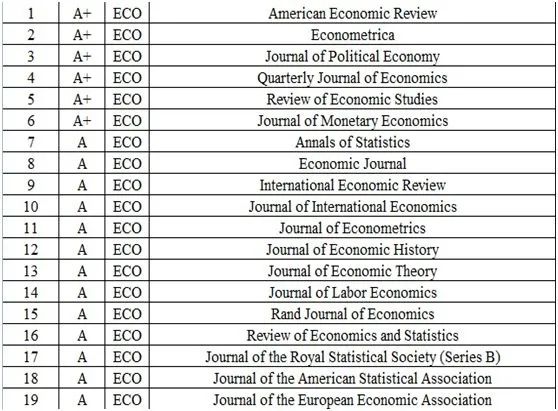
For English papers, please search for articles in international top journals of economics, and please try to choose articles in recent 10 years, as shown in the following table:
Table 1 List of Economic Authoritative Journals (Part)
(2) Search the website of authoritative journals and the conference information held or advertised by WeChat WeChat official account to find the direction of topic selection.
At present, the WeChat official account of Chinese economic periodicals such as Economic Research, Managing the World, Finance and Trade Economy and China Industrial Economy are all active, and will push various articles and conference information.
(3) Search and pay attention to the following meetings and articles.
1. Search the topics and research directions of famous societies such as the annual meeting of economics and the annual meeting of finance. Pay attention to the conference papers of top conferences such as AEA and AFA in the United States. This is also a good place to download papers.
2. Pay attention to some academic papers and push relevant academic information of WeChat WeChat official account. For example, express delivery of frontier papers in finance, Cinnamomum camphora Economic Academic Circle, Paper Stuffy Pot, Haw Hall, Great Financial Thought, etc.
3. Participate in various academic forums and other academic conferences organized by the school to find the direction of topic selection.
4. You can also find topics from financial news and research reports. Economic Observer, Caixin.com, FT Chinese Network, CBN, "Chief Economist Forum" WeChat official account, etc.
5. You can pay attention to Vox(https://voxeu.org/) and voxchina (http://www.voxchina.org/). These websites are the websites where economists write academic Weibo for their academic papers.
So, what kind of topic is an easy topic to do? The following is an idea that is easy to write a paper (but not necessarily very meaningful).
(1) Choose a small topic. Make a mountain out of a molehill. For example, "From the Perspective of Behavioral Finance * * *" and "Research on the Impact of Internet Finance" are not particularly good topics because they are too big.
(2) Select the topic for which data can be obtained. Financial Technology * * *. Whether data can be obtained on this topic needs to be determined first. You cannot make a silk purse out of a sow’s ear.
(3) Select the research topic of the influence of X on Y.. Here, both x and y need to be measurable. For example, "Research on the Impact of Interest Rate Marketization on Commercial Banks" may not be a very good topic. Here, there may be a problem with the measurability of x and y.
The topic can come from financial news or academic papers. So, what’s the difference between the two?
Generally speaking, the topic selection of financial news is often closer to reality and grounded, and the significance of topic selection is often greater. The topic selection of academic papers is more academic, but it is not necessarily happening in reality, and everyone is most concerned about it.
It is very difficult for beginners to choose topics from financial news, and it is difficult to find an accurate academic breakthrough point and choose a suitable academic method. Selecting topics from academic papers is suitable for beginners, and it is easy to produce "results" by simple combination, but it is hard to say how much the meaning of the articles is.
02 find literature
Searching for literature mainly includes the following points.
(A) English papers are suitable for academic search engines-searching for keywords.
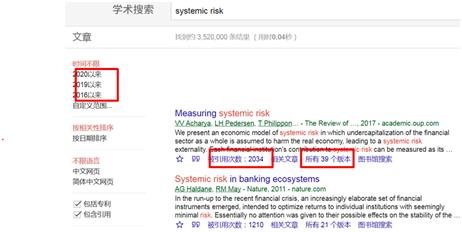
You can search by keywords through Baidu Academic, Google Academic, Google Academic (https://gfsoso.99lb.net/) and Bing International Edition.
When searching, you can choose the year and the articles cited from these articles.
Figure 1 Search engines search for documents
You can consult your tutor on the topic selection. Under the guidance of the tutor, choose a meaningful and operable topic according to your own research interests.
(B) Chinese papers from the China Knowledge Network (CNKI) search (http://www.cnki.net/)
Chinese economic journals: Economic Research, World Economy, Economics (Quarterly), Managing the World, etc.
Chinese financial journals: Financial Research, International Financial Research, Financial Supervision Research, etc.
Other Chinese periodicals: journal of management sciences in china, China Industrial Economy, Finance and Trade Economy, Economics Trends, Finance and Economics Research, Nankai Economic Research, etc.
Other periodical papers in the CSSCI periodical catalogue.
You can download papers according to the number of downloads and citations, or download papers in authoritative journals.
(C) English unpublished academic papers website (Working Paper: unpublished frontier papers, generally downloadable)
(1) Social Science Research Network (SSRN) http://www.ssrn.com/en/
(2) Economic Papers: http://econpapers.repec.org/
(3)IDEAS: https://ideas.repec.org/
(4) NBER http://www.nber.org/.
(5) Federal Reserve: http://www.federalreserve.gov/econresdata/default.htm
(6) International Monetary Fund (IMF Working Paper): http://www.imf.org
(7) Bank for International Settlements: http://www.bis.org/list/wpapers/
(8) European Central Bank (ECB working paper)
(4) Just track the homepage of the domain cattle people regularly.
If you stay in a field for a long time, you can know some awesome people. You can track the research of cattle people.
Take Systemic Risk as an example, V.V.Acharya of NYU stern, Tobias Adrian of NYU Vlab Experiment (https://vlab.stern.nyu.edu/). S.S.Shin of BIS and Markus K. Brunnermeier of Claudio Borioprinceton University. Jon Danielsson of LSE and LSE Systemic Risk Centre. Rama Cont of Imperial College London and others can be concerned.
03 reading literature
In such a "free period", please seize the opportunity to systematically accumulate a large number of academic documents.
Literature reading is also skillful. Generally speaking, only those who have written papers can read them better.
(A) the way to read literature depends on the purpose of reading literature.
For the purpose of learning to write, you can read only the international top 5 and the top papers of domestic economics. This research topic has nothing to do with the thesis, because the writing of authoritative journals is often first-class.
For Chinese, you can read the papers of Economic Research, Managing the World, World Economy, Economics (Quarterly) and Financial Research. Don’t focus on the method and theme, see how others express it. At this point, you must be careful when reading the paper. Look at people’s words and sentences, how to organize logical relationships, etc.
For literature reading aimed at finding research topics and methods, don’t just read the top papers. It is necessary to give priority to keyword search and give consideration to periodical grades. To learn how to make a paper and find a research topic, you need to find a paper that suits you. Find the dish that suits you. Here is to introduce the "three-step" reading literature.
(B) "three-step" reading literature to find research ideas
The first step (initial stage): "Hungry for food" (extensive literature search)
Literature review and keyword search are the main methods.
On literature review and search. You can find it in journals that can publish authoritative literature reviews. For example, chinese magazine has Economics Trends and International Financial Studies. English magazines include Journal of Economic Perspective and Journal of Economic Literature.
You can also find the literature by searching for "keyword+Survey(Literature Review)".
The second step (mid-stage): "Looking for him in the crowd" (extensive reading of literature)
Browse literature review, reference list and other related documents and other related documents searched by keywords.
Focus on the introduction and conclusion of these documents. Need to take notes.
Browse the basic model and data table of the article, find out whether you can hold this article, and mark the articles that you can hold. Don’t eat it if it’s not your dish! Focus on the following questions
Theoretical model, can you understand it? Can you change it?
Measurement method, can you program it?
Data, can you find it?
Find articles that often appear in various articles and mark them.
The third step (closing stage): "looking back suddenly" and "stalking and beating" (intensive reading of literature)
Print the marked articles into books and read them repeatedly-read them well.
Find a few closest articles, carefully compare their advantages and disadvantages, and don’t give up every detail-intensive reading.
At this point, either give up the footnote or the Appendix.
Focus on solving the model, where to find the data, and how to deal with the data.
How to realize the measurement method by software? How to generate tables? How to draw graphics?
Take one of these closest articles as a template and ponder it over and over again, so as to replicate the results.
Based on the copied template, relying on the related literature, and according to your own association, these articles are spliced and combined, so as to get your own article template. (the prototype of the self-created article has been made! )
"Three-step method" is not omnipotent, but also has its own advantages and disadvantages.
"Three-step method" is a quick method of writing, which is only suitable for beginners. Beginners need small incentives, especially the first article they have made, which is very motivating. If the motivation is done well, the interest will be there. It is possible to make a big article later.
However, the innovation of articles obtained by "three-step method" is generally not too high. Because the articles found are similar, simple splicing is just a physical reaction. Small marginal contribution in literature research.
In addition, if you have a very deep knowledge of literature in the early stage, chemical reactions will occur for articles in completely different fields after their own deep processing and complex splicing. This is a great marginal contribution in literature.
It should be pointed out that these are all researches from literature to literature. Not necessarily from real problems, not necessarily grounded.
04 collect data
Regarding how to collect data, there are several places to go.
(A) the professional database purchased by the school
Go to the school library to find the database, which is the most effective. Our financial colleges and universities have comparative advantages in this respect, and there are many databases about finance and economics.
The search path is as follows: http://lib.cufe.edu.cn/ → Resources → Chinese database, foreign language database and trial database.
(1) Statistics of China Economic Net
The macro and industry data of this database are complete.
(2)RESSET financial research database
This database contains all the financial market and company financial data.
(3)Wind database
This is the best database for China finance. You can go to the teaching technical service center of the school website to find Caiyun platform and apply for the use time of Wind. Or go to the electronic reading room on the east side of the first floor of the library and use the computer’s Wind terminal to download data.
(4) Guo Taian
This database is suitable for downloading financial statements of listed companies, and it is advantageous to do related research on corporate finance and financial markets.
(5)EIU CountryData Database
This is a global macro database. It is better to be macro.
(6)CEIC database
Make a better database of global macro and international finance.
(7) Global Bank and Financial Institution Analysis Library
This database is a good database for banks and a concentration camp for financial statements of banks and securities companies.
(8) Analysis Database of Global Listed Companies
This database is the place to download the financial statements of listed companies.
(2) Publicly available databases
(1) Juchao Information http://www.cninfo.com.cn/
Where to download the annual reports of listed companies in China.
(2) National Bureau of Statistics
(3) China People’s Bank (Financial Statistics)
(4) Federal Reserve
(5) European Central Bank
(6)CEPII database
(7) China Free Trade Service Network
(8)World Economic Outlook Database
(9)WDI database
(10)UNDATA
(11)UN COMTRADE
I hope that when you do research, you can be a conscientious person and pay more attention to the data sources in some articles.
(C) NBER database of open scholars
Link: https://data.nber.org/data/
Contains the following word banks:
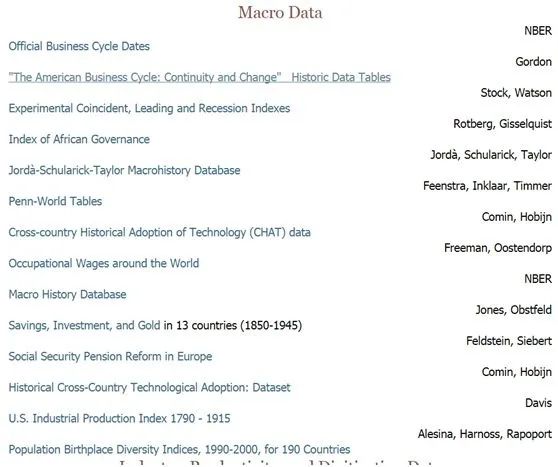
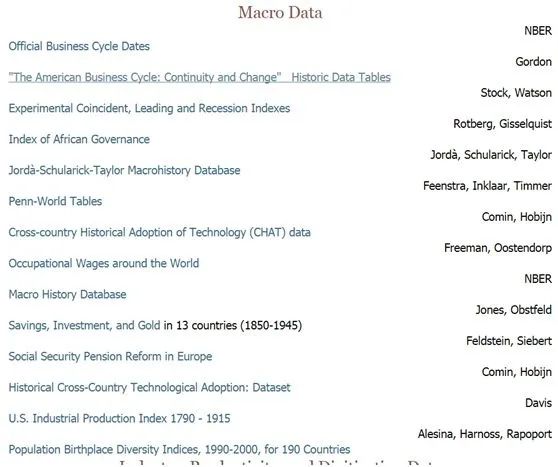
Macro Data
Industry, Productivity, and Digitization Data
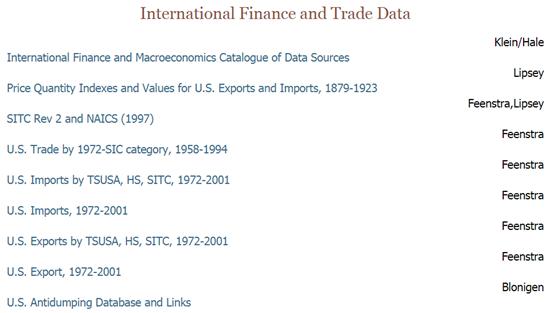
International Finance and Trade Data
Individual Data
Healthcare Data — Hospitals, Providers, Drugs, and Devices
Demographic and Vital Statistics
Patent and Scientific Papers Data
Other Data
Figure 2 where NBER downloads data
Figure 3 Macro Database
Figure 4 International Finance and Trade Database
The database of international finance and macroeconomics catalogs of data sources contains the following sub-libraries:
(1)Capital controls and macro-prudential
(2) Exchange rate regimes
(3) Financial crises
(4)Fiscal data
(5)Bank ownership
(6)International price data
(7)International capital flows and interest parity
(8)Financial Development and Central Banking
(four) survey and statistics database, etc.
These are all microscopic databases of China.
(1) Southwestern University of Finance and Economics China Financial Survey Database.
(2) National Balance Sheet Database of National Finance and Development Laboratory.
(3) China Health and Retirement Longitudinal Study (CHARLS) in China, Peking University.
(4) China Household Income Survey of Beijing Normal University (CHIP).
(5) China industrial enterprise database.
(5) Private data
This mainly refers to the private data obtained through their own private channels or partners. Pay attention to data desensitization and avoid breaking the law.
You can use a big data crawler (pay attention to the anti-scraping mechanism and pay attention to breaking the law), or you can manually organize the database.
05 processing data
(A) data cleaning
Data cleaning is the first step to do a good job of research. It is also a very crucial step.
Data cleaning is to sort out the collected data into the data needed for measurement or model simulation.
The data type can be cross section, time series and panel type.
When cleaning the data, try not to eliminate the observed values, and try to save the original data.
When doing data cleaning, it is recommended to use STATA software to do data cleaning. This is the most commonly used command of STATA and its purpose:
Drop (keep)-eliminate (keep) variables or observations.
Gen/replace-generate/modify variables
Rename-Modify the variable name.
Label-Assign a label value to the variable.
Sort/gsort-sort the observed values of variables.
Order-Sort the order of variables in memory.
Merge-Merge different data sources (horizontal integration)
Append-Merge different sub-samples from the same data source (vertical merge).
(2) Statistics
It is very important to know your data. If the data is wrong, the paper must be wrong.
Before doing research, you need to ask yourself a few questions.
What is the data frequency? Is there any missing value? Are there any abnormal values? Where is the range of variables? How big is the data sample size? What is the data unit?
It is suggested to use STATA software for data statistics:
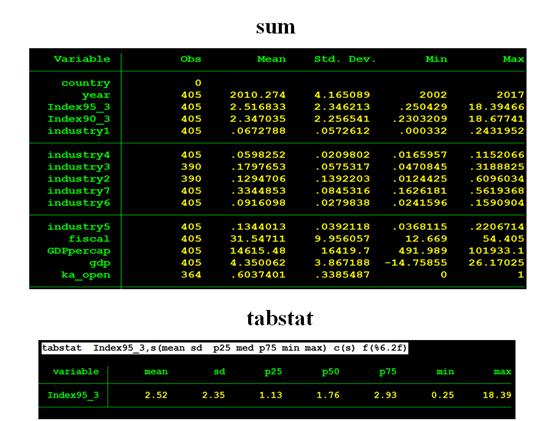
Sum-the most commonly used descriptive statistical table
Tabstat-You can get the quantile of each variable.
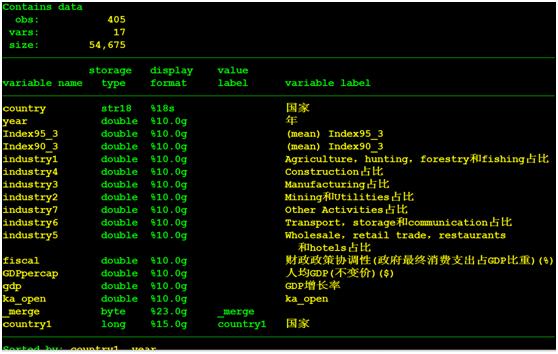
Describe-get the information of each variable
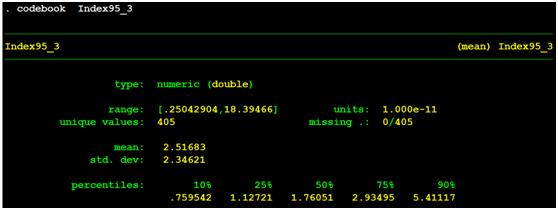
Codebook-Check the internal information of variables in detail.
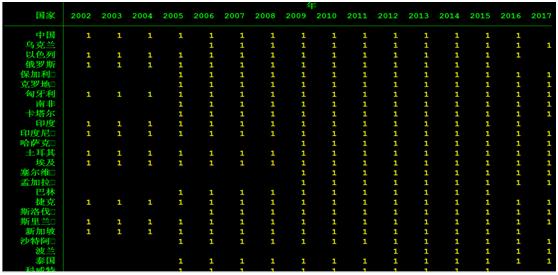
Table-get the frequency table
Two way scatter/two way line-get the scatter plot.
Winsor-remove outliers
Nmissing-Find the number of missing values.
Ipolate-interpolation
Figure 5 sum and tabstat
Figure 6 describe
Figure 7 codebook
Figure 8 table
Sharpening a knife is the first and most important step to write a good paper, so it is necessary to choose a topic, arrange documents and data in the early stage. I hope you will pay attention to the key step before writing your thesis, and wish you all a smooth research.
Swipe up and down to view the full text
seven
"When winter goes and spring comes, it is a good time to accumulate wealth."
Speaker: Travel around
Associate Professor of Law School, Master Supervisor, Executive Director of Asset Management Rule of Law Research Center, and Deputy Director of Commercial Law Teaching and Research Section of Law School; Peking University, doctor of law, visiting scholar at Taiwan Province University and Tohoku University. He is also a director of the China Commercial Law Research Association and an external expert of the Postal Industry Security Center of the State Post Bureau.
"When winter goes and spring comes, it is a good time to accumulate wealth."
travel around
Thanks to the trust of the graduate school, allow me to write some words to encourage my classmates to continue their study and research at home. I have always felt the need to write some words. Two nights ago, the graduate students who received their own guidance sent nearly ten papers to me for approval, and told me that they would submit them to the college at 22 o’clock that night, which made me feel more necessary to write some words.
At the beginning of the Spring Festival in 2020, the sudden COVID-19 outbreak touched everyone’s heart, and also affected our original step-by-step study and life. During this postponed school term, the routine operation may be eating and sleeping, sleeping and eating, and "Ge You Lie" in thousands of postures. However, in fact, there may be another correct "opening way"-if you consciously "charge" and "burn your brain", now may become a critical period for you to stand out and be different.
Delaying the start of school is not a holiday, it is a "holiday ([ji m]) period" … I hope that after reading this tweet, this sentence will always reverberate in your mind. ^_^
Everyone can be the most beautiful retrograde person on the road to knowledge.
During the epidemic, how many people went to the front line to fight the epidemic, they were all the most beautiful retrograde people. As teachers and students, there are actually positions that you and I need to hold on to. When many people are bored at home, if you can study quietly, you are also the most beautiful retrograde person.
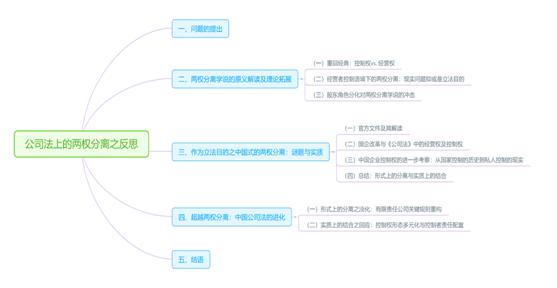
Looking back at history, all successful people have some characteristics of "survival in adversity" more or less. I tend to understand "survival in adversity" from another perspective: this does not mean bravely facing setbacks, but you have to do the opposite when everyone does that. For example, when others are rushing to the frontier issues and have published many articles, we can make some cold thoughts on them based on related traditional propositions. Take my own research as an example. Although commercial law is considered to be one of the disciplines that are most closely related to business practice, in recent years I have also made a hard attempt to do some research on traditional propositions, such as reflecting on the separation of two powers, the enterprise unit system, the nature of equity and the function of company law, etc. Thanks to the periodical editors, I have published some papers one after another. The reason why I made such an attempt is that I gradually discovered that traditional proposition research has three characteristics: constant innovation, alienation and cross-border. The so-called constant novelty refers to the fact that the traditional proposition can be called a traditional proposition and has attracted the attention of academic circles in different periods. It must be because it has the vitality of keeping pace with the times, and even if the situation changes, it will never leave its Sect. The so-called alienation refers to the fact that traditional propositions have a long history and are often misinterpreted by contemporary people, which makes them unable to effectively guide contemporary practice, so it is necessary to dispel the fog and root out the source. The so-called cross-border means that the research of traditional propositions (especially in the field of law) often needs the help of excellent achievements in other disciplines, so that it may achieve more remarkable results in research methods.
However, this is by no means advocating that you should do some abstract theoretical research. The study of basic theory can not only be from theory to theory, but also try to examine the current practical problems from a longer-term perspective and pattern. Therefore, cold thinking requires not only courage, but also confidence-reading more, writing more, diving more, accumulating more, and consciously practicing highly recognizable research methods, etc., all of which are the sources of confidence.
02 reading pleasure: different aspects of reading.
Su Shi said, read widely and take about it, and accumulate it with little hair. I often joke that "thick accumulation and thin hair" is a true portrayal of academic work: a lot of papers have been written, but a few papers have been published. However, this does not go against the truth-more and more articles have been rejected, and in fact, the closer they are to successful publication. The starting point of all good papers, without exception, is the massive reading from the heart with a passion.
Reading from the heart is for pleasure. Generally speaking, there are three kinds of understandings about reading: technical reading, intensive reading and enjoyable reading-those who have achieved academic success are technical reading, mainly textbooks for exams; There are specialized books for study, mainly for getting a degree; Those who are interested in everything are happy to read, casual and free. Of course, studying with the curiosity of not solving puzzles is undoubtedly enjoyable. The main problem of many students is that they feel sleepy when they open books, and they are not happy. The phrase "learning from the sea is endless and making a boat" has delayed many young people’s journey of reading. The root of the pain may lie in utilitarian reading-what this book can give itself.
Why study? Nietzsche said that the study of utilitarian purpose is bound to have no real interest. Havel said, we insist on one thing, not because it will have results, but because we firmly believe that it is right. In fact, it can be said that it is simpler, that is, not why. Reading is nothing more than a pleasure. Hu Shi said it well, fearing that the truth is endless, and there is an inch of joy in every inch.
You may say that you have no time to read because of the short school period and various chores. Excuses are excuses. No matter how busy we are, we still eat, sleep and fall in love. As long as you get used to it, you will like it. How to form a habit? Here are some immature suggestions:
(1) Use events instead of time as reading trigger. Many students are used to making reading plans like this: reading for 1 hour at 9 pm; The reality is: the community dinner is at 10 o’clock; Result: Reading is ruined. You know, time is uncontrollable, but some events are inevitable. Try to change the way you plan: read for 20 minutes after lunch or before going to bed. Look, you can’t escape unless you fast all night.
(2) Make full use of corner time. Many students are used to spending a whole block of prime time reading. In fact, this practice is not recommended unless they are reviewing exams or professional books that they have to read. Following the previous point, we can try to read after meals, before going to bed or in our leisure time, and each reading time does not need to be too long unless we have the will to continue reading.
(3) Don’t set the reading task too heavy. Many students are used to setting up some impossible flag on impulse, such as reading a book in two days, or forcing themselves to challenge an extremely difficult book, which will reduce their interest in reading. Especially in the early stage of cultivating habits, it is best to start with simple tasks, such as reading 5 pages a day; Then, every day you may be overwhelmed by overfulfilling your tasks, and then slowly increase your reading tasks.
(4) Take notes, especially electronic notes that can be "reproduced". Many students are used to taking notes by hand, which may make you spend a whole day rummaging through everything in order to find a record. Taking notes by mobile phone or computer, you can quickly find the notes you need through the search function, take notes in crowded places such as subway, and synchronize your notes.
All right, stop dawdling and start. To paraphrase: The best time to start reading is ten years ago, followed by now.
Writing: There are countless rules and regulations, and the Tao is natural.
Of course, even if you love reading, writing is still a painful job for most people. A few years ago, I wrote in the postscript of my doctoral thesis: "Those so-called big things are often small. When we choose to love a small thing, we are doomed to enjoy envy in a small part of the time and have to endure loneliness in most of the time." It takes a lot of determination to make steel. Every time you write an article that satisfies you, you will definitely feel that all the hard work before is worth it.
It is true that writing needs to pay attention to methods. But it may be more accurate to say that every article written by everyone may need to use the corresponding methods. At the beginning of writing a thesis, try as many different methods as possible to explore one or more of them that you are best at. In the same article, it is suggested to use one method to run through the whole article, which can be supplemented by other methods to analyze some details. In the final analysis, the use of writing methods is closely related to everyone’s reading surface and reading volume-many awe-inspiring scholars have distinctive personal characteristics in their articles and writings, and such recognition is often the perfect fit between reading and writing. At this point, it doesn’t matter what method is used.
In the process of writing, you must communicate with your tutor more. According to my own experience, even a cold teacher will be softened when he meets persistent students. After all, it is the right way to contact teachers frequently because of academics. Of course, according to my own lessons, it is best to pay attention to the following points when discussing paper writing with my tutor:
(1) The "deadline" is for you, not for your mentor. If today is the deadline, you must send the paper to the tutor more than one week in advance. After all, you only have one tutor or doctoral tutor, but you are not the only tutor.
(2) With the framework, the tutor can communicate with you peacefully. Every time I meet a student asking what topic to write in a paper, or how to write a certain topic, I feel a little angry. There is no topic you can’t write, whether it is cutting-edge or traditional. The key lies in your preliminary opinion on the topic itself. Therefore, it is best to discuss the paper with the tutor by reading the corresponding literature, drafting the general framework of the article (it is suggested to make full use of mindmanager, as shown below), and attaching the corresponding materials, so that the tutor can give constructive suggestions.
(3) Pay attention to the formality, and check the format, words and punctuation more so that there is no dead angle in 360 degrees.
Teachers read a lot of literature, and even if the line spacing of different paragraphs in the article is only 0.01 times different, it will be dazzling, so don’t take any chances. Before submitting any article (even the first draft) to the tutor, it is best to stylize it, which is actually an important stage to improve your own paper.
In this special period, in fact, tutors are really idle at home except for being tortured by online classes for a while. Take this opportunity to contact them by email and other means to talk about their papers and future.
Finally, return to the original.
Whether reading or writing, the purest is often the most valuable and attractive. So, how to improve the "purity" of your own research? Limited by space, here are a few words.
First of all, pay attention to the native land and don’t love the other side. Whether it is a theoretical or practical problem, since it is China’s problem, we need to pay more attention to the local elements to solve the problem. Extraterritorial resources should be fully used for reference, but it is a means rather than an end. What exactly is China’s contribution-both we and you need to reflect on it.
Secondly, reading and writing can try to pay more attention to the historical perspective. This is closely related to the previous point, and all current problems are nothing more than the repetition of history. A civilization with a long history is sometimes an advantage and sometimes a fetter, but it will never be able to get rid of it. Resource endowment is contained in the long river of history and is an important treasure for our study and research.
Once again, present the truest self. Don’t follow suit, don’t follow the fashion, whether reading or writing, always confirm what topics you are interested in. Especially when writing a thesis, try to show your strengths as much as possible. For example, students who are illegal in this field should combine their undergraduate studies as much as possible, and strive to study the breadth; It is best for a master of French or a master of learning to determine his own research direction as soon as possible, and constantly dig deep into some details to strive for the depth of research.
In a word, it is to return to the original.
It’s February in the lunar calendar. Winter goes and spring comes, which makes us all better ourselves. The so-called "good" must not have a unique paradigm. We just need to improve our recognition as much as possible and reduce our substitutability. Whether it’s "the mountains and rivers are different, the moon and the sky are the same" or a simple "come on", it’s good to have a heart.
Swipe up and down to view the full text
eight
Scientific research is a lifelong event
Speaker: Li Xiaorong
Professor, Doctoral Supervisor, Vice President of School of Finance and Taxation, Head of Asset Appraisal Institute, winner of Fok Ying Tung Fund of Ministry of Education, the first batch of "Dragon Horse Scholars" young scholars of Central University of Finance and Economics, Ph.D. in Management (Finance) of Business School of Renmin University of China, visiting scholar of Columbia University in the United States, concurrently serving as Deputy Secretary-General of Graduate Education Steering Committee of National Asset Appraisal Professional Degree, member of National Asset Management Standardization Technical Committee, member of Education and Training Committee of Beijing Asset Appraisal Association, etc. He once worked as a research assistant at the Chinese University of Hong Kong.
Scientific research is a lifelong event
Li xiaorong
At this time in previous years, graduate students should be busy with classes, internships, academic activities, writing papers or looking for jobs at school, and proceed in an orderly manner under the arrangement of the school. However, the sudden epidemic has forced students to stay at home. In order not to affect the development of students, the school has made various thoughtful arrangements to make the disorderly life orderly. Nevertheless, the changes in space and mentality brought about by the epidemic will inevitably have adverse effects. In the previous issues, teachers put forward many effective suggestions on how to write papers at home, which are very comprehensive and specific. Therefore, I will not talk about how to write papers any more, but just want to put forward a point of view: scientific research is a lifelong event, hoping to change some students’ views. If more students can pay attention to scientific research, it will be considered as the contribution of writing this essay. Around the viewpoint that "scientific research is a lifelong event", I mainly talk about three aspects: the common problems existing in postgraduate stage, the value of scientific research and the methodology of scientific research.
01 Frequently Asked Questions
According to many years of experience in teaching and guiding graduate students, I personally find that some graduate students have the following common misunderstandings or problems:
(A) learning knowledge is a bounden duty.
Before the first class for graduate students, I often ask my classmates what they want from the class. Most of the answers are to learn more knowledge. Learning knowledge is important, but the main task of graduate students is not to learn knowledge, but to create knowledge. If the postgraduate stage still focuses on learning, it will enter the post-undergraduate stage, not a real postgraduate. In order to create knowledge better, we should not neglect the cultivation of critical thinking and innovative thinking. In the undergraduate stage, we may accept all the knowledge taught, but in the postgraduate stage, we should learn to question, criticize and innovate. Even if the documents posted in Top Journal are re-anonymously reviewed, there are still 10,000 reasons to refuse, and Mr. Daniel will make mistakes sometimes. Therefore, we should learn to think independently, to question and criticize. Failure to find a problem actually reflects the limitations of your thinking. Criticism is the way to find a problem, and in fact, criticism is also the beginning of innovation. Regarding the cultivation of innovative thinking, I encourage students to think more, even if it is irrelevant, it is better than repeating other people’s views.
(2) Internship and textual research are king.
At present, a serious problem for graduate students is that they attach too much importance to internship and textual research. They start internship and textual research as soon as they enter school. Even if people are in class, they are absent-minded, and their soul and body are separated, let alone scientific research, and they even sneer at academics. In this case, I think they are not graduate students, but at most they are "on-the-job graduate students" (work is the main business, and classes and scientific research are sideline businesses). One of the problems caused by this phenomenon is to deal with the course papers and graduation papers, and the quality of the papers is getting worse. Personal experience in guiding graduate students for many years shows that the internship time is negatively correlated with the quality of papers. The more internship time, the more time you occupy for scientific research and the less energy you spend on papers. I’m not against internship and textual research. Internship and textual research are really beneficial to finding a job, but we can’t ignore the cultivation of research ability in graduate stage. The certificate can be tested after work, but it’s hard to cultivate research ability without the platform of the school. How can there be such a strong scientific research atmosphere and high-quality resources in the future? This epidemic deprives students of internship opportunities, but it is a good opportunity to improve the quality of scientific research. I hope that students can use their time at home to read more documents, do more scientific research and write high-quality papers. When you are old, will it be a good memory to recall that you have published papers in a well-known journal? Or there is a high-quality paper published on your resume, no matter what career you are engaged in in in the future, people will look up to you.
(C) the paper lacks innovation
Whether it is a course thesis or a graduation thesis, it is difficult to find any papers that shine at the moment. Most of them are repeating other people’s stories, or adding a situational variable, or changing the sample period, or simply copying foreign papers, which reflects the lack of innovative thinking and does not know how to find research problems. Professor Chen Xiaoping of Washington University put forward four methods to find research problems: phenomenon-driven method, method-driven method, inspiration-driven method and literature-driven method. I quite agree with him. Phenomenon-driven method refers to finding research problems according to the phenomena that appear in reality; Method-driven method is to use new research methods to study problems; Inspiration-driven method refers to the research problem of inspiration selection based on sudden; Literature-driven method refers to finding missing variables from previous literature, thus raising research questions. Personally, I think that no matter what kind of research problem you choose, it can give people new knowledge and change readers’ view of the world, which is considered innovative.
(D) Chose the wrong "giant’s shoulder"
Standing on the shoulders of giants is particularly important for academic research. However, some graduate students have the problem of choosing the wrong "shoulders of giants" and treating their graduated seniors and sisters as "giants". I often wonder why students often make the same mistakes in their graduation thesis every year, and even I repeatedly emphasize the problems that can’t appear in class, and I still make the same mistakes when writing my graduation thesis. I think about it carefully, and perhaps the main reason is that the common way for students to write their graduation thesis is to look at how their seniors write their graduation thesis, thinking that they can pass the defense if they write it according to their thesis paradigm, but I don’t know that your seniors’ graduation thesis has many problems, and some of them even pass by luck. So what is a "giant"? Papers published in top journals are "giants", and they have undergone strict peer anonymous review. The better the journal, the more demanding the reviewers are, and the quality of the papers is guaranteed after anonymous review. The anonymous reviewers of top journals are also top, and the papers that can be published represent the research taste of top scholars. Therefore, we should read more, learn more and quote more papers from top journals.
The value of scientific research
Personally, I think that scientific research is not only for obtaining graduate degrees or publishing papers, but also for thinking training. The skills or thinking training obtained in scientific research can help you take every step of life and help you succeed. It is the methodology of any career, so it should be treated as a lifelong event.
(A) the source of ideas
The slogan of Guanghua School of Management, Peking University is "Brilliant because of thoughts". On the basis of this expression, President Liu Qiao added six words "Thinking because of academics". My feelings are the same. Academics produce thoughts, and scientific research is an important source of thoughts. Looking at many successful people, they are very thoughtful. They change the world because of their thoughts and get respect because of their thoughts. Scientific research teaches us to be different (innovative). This difference allows us to find more ways to solve problems or more efficient ways to do things. Therefore, it is suggested that students take scientific research seriously and temper their thoughts with scientific research methods, which will benefit you for life. The scientific research here does not mean writing papers chivalrously, but looking at and thinking about problems with scientific research methods.
(B) affect life and work.
As a man, your attitude towards scientific research can reflect your attitude towards being a man. Those who are meticulous in academic research will also be meticulous in what others have told them, and they will be strict with their research and their own lives. They will be eager for quick success in scientific research and eager for quick success in life. Scientific research affects life and work in at least three aspects: First, the rigor of scientific research makes people more rigorous. Xu Shuying, a famous professor of management, thinks that the key to the success of paper publication lies in the rigor of the scientific research process itself. If you go through systematic scientific research and training, it can help you to be more rigorous, and rigor is a good quality, which can help you gain trust and improve the quality of work. Academician Zhong Nanshan mentioned in an interview that "when you look at a thing or do a research, you should have a factual basis and don’t jump to conclusions easily", indicating that scientific research and doing things are the same. Second, scientific research attaches importance to logic to help you speak, write or do things more logically. Whether it is logical or not is an important aspect to judge the quality of a thesis, especially for graduation thesis. In the process of instructing students to graduate thesis or giving students a defense, logic is mentioned the most. Many students have the problem that they don’t know how to lay out their essays. The whole thesis seems to be logically chaotic and doesn’t revolve around the center of the article. I think after the guidance of teachers and the training of scientific research, it will be more logical to speak and do things in the future. Third, scientific research helps to improve the level of writing and expression. There are a large number of course papers in the postgraduate stage. If you take each one seriously, the level of writing and expression will be greatly improved.A practical expert once mentioned why they want graduate students, because graduate students have at least tens of thousands of words of writing training. In fact, employers recruit graduate students instead of undergraduates. What they value is the research ability of graduate students. Graduate students have high human capital, and their future goal is to move towards management positions. Writing and expression skills are essential. If you want to start a business after graduation, scientific research will also help you. Scientific research needs to choose a good project. In order to land this good project, it is necessary to manage this project, invite like-minded collaborators, do a good job in research, and then market it. This is the same as the logic of starting a business.
(C) improve emotional intelligence
There are ups and downs in scientific research. The experience of each paper creation is actually a life story. Most of the time, it is boring and lonely. If you can stand the loneliness of scientific research, you can also achieve great things. We have written many papers, of which only a few can be published in well-known journals. Even Daniel has rejected many papers. In life, we rarely hear others accuse you of your shortcomings, unless you are very close, which makes you lose many opportunities to correct your shortcomings. When you encounter setbacks, you may be at a loss. However, scientific research is different. Many people find fault with you, especially in anonymous evaluation, and the reviewers don’t know your identity, so you don’t have to worry about your face. You may criticize the shortcomings of your paper without reservation or even "pick bones with eggs". You may not be able to stand this kind of "spite" when you first do scientific research, but after many submissions, you will develop the ability to resist setbacks. This kind of belittling criticism and facing negative opinions.
03 scientific research methodology
Since scientific research is a lifelong event, how to better handle and complete the lifelong event? When writing this article, I thought of a few points, but it is definitely not comprehensive. I hope it will help.
(A) to master the method
First of all, we need to master the technical methods of scientific research. For example, doing empirical research requires econometric knowledge and skilled statistical software operation, so we need to spend a lot of energy learning measurement and statistical software in the early stage of research; Secondly, the experience and methods of predecessors’ research. Many websites or WeChat WeChat official account will publish the research methods of well-known scholars, and the school will also invite well-known scholars or periodical editors to talk about their research methods or contribution experiences. The series "Teach you to write papers at home" invited by the graduate school is good learning materials. These materials are valuable experience accumulated by them all the year round, which can save you a lot of detours. It is recommended that students use a folder to collect the introduction of successful experiences of some well-known scholars and study hard.
(2) Find topics of interest
A classmate once asked me how to keep my enthusiasm for scientific research. My opinion is to find a topic of interest. Some students will say that I fall asleep when I look at the literature. I think the literature is vast, and there is always a field that you are interested in. When you read a literature that you are very excited and want to continue reading, delimit the topic or field of this article. This field is the topic that you can study. One of my motivations for engaging in academic research is that I can choose any topic I am interested in to study, get happiness in my research, and get some recognition at the same time. Einstein believed that the ultimate goal of science was to "improve the lives of ordinary people". I think scientific research should first make myself happy, and then take into account the pursuit of this ultimate goal.
(3) Diligence
"One minute on the stage, ten years off the stage", to become an expert in a field, it is bound to take several years of hard work, especially academic research. Many well-known scholars have paid a lot of hardships behind their brilliant publications. In fact, scientific research does not need too high IQ. As long as you are diligent enough, you can finally get a place in academic circles. In the future, academic competition will be more intense. In the early days, there were only a handful of papers published by China in top international journals, and it was great to be able to publish articles in international journals. However, with the academic development, if you don’t publish a top international journal in the future, it is estimated that it will be difficult to get recognition in the academic market.
(4) Cooperation
In scientific research, students often "fight alone", which is not conducive to academic progress. Looking up the papers published in top international journals, you will find that most of them are co-published, and there are very few articles by independent authors. Cooperation has many advantages: cooperation is an opportunity for learning, especially for students who have just started scientific research. They should look for opportunities for cooperation, cooperate with teachers or classmates, or cooperate with other well-known scholars. After cooperation, their academic level will improve; Cooperation can improve efficiency, and an empirical article takes a long time. If several people can work together, it will greatly improve the efficiency and output of scientific research. Cooperation can inspire generate, the research perspective is more unique, the research is more rigorous, everyone’s experience is different, and the way of looking at problems is different. Through discussion, new inspiration can often be inspired; Cooperation can also encourage each other and maintain enthusiasm for scientific research. It often takes several years to publish papers in international journals, and revising opinions will often make you "peel off a layer of skin". If a person is quite depressed, you can encourage each other when you have collaborators, stick to the topic of "fun" until the end, and you may be tired of it after several years of revision. At this time, it is necessary to encourage and urge the collaborators. Many students may ask, how can we cooperate when we can only stay at home during the epidemic? In fact, cooperation doesn’t have to be met. Modern technology is so developed that we can communicate by email, WeChat, etc. Several of my collaborators have never met.
That’s the end of it. I hope students will take scientific research as a lifelong event and pay attention to it. Don’t be affected by the epidemic, and their efforts will eventually pay off!
Swipe up and down to view the full text
nine
The initial intention and problem consciousness of academic research
Speaker: Cao Tangzhe
Associate Professor, School of Government Administration, Deputy Director, Department of Administration. Visiting scholar at the University of Texas at Austin (2015-2016), whose main research areas are government budget performance management and public management theory and method.
The initial intention and problem consciousness of academic research
Cao tangzhe
In the 14th century, the Black Death swept through Europe, when Newton was studying at Trinity College, Cambridge University, and spent 18 months in isolation in Woolsop’s country estate. This period became the starting point of his later research and innovation in calculus, gravity and optics.
01 the initial intention and internal skill of academic research
How can we make our academic research innovative, make contributions and move towards Excellence? Just as the road to success is only "diligence"; There is only one road to outstanding academic achievements, and that is "innovation". As Schumpeter said, "innovation" of "establishing a new production function" is the soul of market economy. Then the academic "innovation" that contributes to the marginal improvement of human knowledge is the soul of academic research and the "initial heart" of academic research.
If we say that there are eighteen internal mental methods for the eighteen palms of the dragon, there are not so many internal mental methods for academic research, and there are three types: one is to ask questions; The second is to use scientific methods to solve problems. The third is to condense knowledge into theory; Today, we will talk about one of the internal psychological methods of academic research and ask questions.
02 the starting point of ronald coase’s "deification"
Let’s first look at how a sophomore can use this "three styles". This sophomore was born in 1910 in Willesden, a suburb of London, England, with ronald coase. When he was a sophomore, he raised an interesting question. The exploration and solution of this question became the "initial heart" and starting point for him to win the Nobel Prize in his later years and "worship the gods" as the father of new institutional economics.
Ronald coase’s The Nature of Enterprises, written when he was 27 years old (1937), is recognized as the foundation work of new institutional economics. So how did Coase form the analytical paradigm of new institutional economics in this paper, thus expanding the scope of traditional economics on the basis of inheriting the analytical methods of traditional economics?
1. the question is raised. Coase was a sophomore at the London School of Economics in 1931. At the age of 21, he attended a seminar in Pratt, from which Coase learned some basic contents of price theory. His core view is that the "invisible hand", that is, the market price mechanism organizes and regulates production, is the only and most efficient way to allocate resources. However, in reality, Coase found that there is also a way of organizing resources to produce in the market. Although enterprises are active in the market, their internal organization, management and production activities do not need market price mechanism. In addition, economists in the Soviet Union at that time thought that the Soviet Union could run like a huge factory. The contradiction between the theoretical background and the actual phenomenon urges Coase to think about such a question: since the traditional view holds that the market price mechanism is the most effective and only way to allocate resources, why do enterprises exist? Why do enterprises replace the price mechanism? How to determine the scope of enterprise alternative price mechanism?
So how did Coase demonstrate it concretely? ……
The new institutional economics is widely used in public management. Interested students can read The Nature of Enterprises, which will certainly inspire them.
Scientific research begins with problems and ends with problems.
Everything is difficult at the beginning. What is the starting point of academic research? Einstein also pointed out: "It is often more important to ask a question than to solve it. Because solving problems may be just a mathematical or experimental skill, it requires creative imagination to put forward new problems, new possibilities and look at old problems from a new perspective, and it marks the real progress of science. "
In academic research, almost every academic theory is put forward and developed from a specific problem. For example, "Making Democracy Work" written by Italian political scientist Robert D. Putnam starts with the question of whether the regional system determines political practice, and goes further into why there are differences in system performance. Why are there differences in the public spirit of citizen communities? Why are the differences in historical decisions stable? And so on, completed this book on the theoretical origin of social capital.
Ways to doubt and ask questions in an orderly way
K. R. Merton, a famous historian and sociologist of science in the 20th century, thinks that "organized scepticism" is an important temperament of modern science. How to doubt in an organized way? I summed up a few things to communicate with you.
(A) ask questions from the gap between theory and experience.
The so-called "experience" is the phenomenon and fact that we can observe and test. When new experience conflicts with existing theories, and existing theories cannot explain the new reality, problems arise. After raising this kind of question, we need to revise the existing theory or give a new theoretical explanation to the new experience, so as to put forward a new theory. In natural science, there are many cases that ask questions because of the contradiction between new experience and old theory. For example, the discovery of photoelectric effect led to Einstein’s "light quantum" hypothesis in 1905. In social science research, including public management, it is also common to ask questions from the conflict between experience and theory. As mentioned earlier, Coase’s book The Nature of Enterprises is an example.
Asking questions from the gap between theory and reality is an important way to localize western theory. By finding out the contradiction between western theory and China’s reality and seeking a new explanation, it provides an opportunity to build a theoretical academic discourse system with China characteristics, China style and China style. Lin Yifu’s papers such as "Self-growth Ability, Economic Transformation and Reflection on Neoclassical Economics" are based on many western frontier theories. Why can’t he predict and explain the predicament brought by the implementation of "shock therapy", and why can’t he be optimistic about China’s economic transformation? Based on this problem, the theory of autogenous ability is constructed.
(B) ask questions from the gap between subjective needs and reality.
Subjective demand is the goal that individuals, organizations and society hope to achieve and achieve. When there is a gap between the subjective demand and the actual situation, problems arise. In the research of public management, the proposal of new public administration, new public management and the whole government can all be regarded as a system and tool design to meet specific management needs. The analytical method and development of Ostrom system is a typical example of this approach. In The Governance of Public Affairs: The Evolution of Collective Action System, she found through literature review that neither privatization nor government control can solve the problem of public pond resources well, and "the problem of how to best manage the natural resources shared by many individuals has not been well solved in the academic hall or in the political world". What is the collective action of the best governance of public pond resources? Ostrom used the system analysis method of real scene and the "second generation rational choice model" as the research framework to analyze more than 5,000 transnational public pond resources. The description and analysis found that "the framework of autonomous governance system with the best governance of natural resources shared by many individuals". That is to say, "essential elements or conditions are found, which help to explain the reasons for the success of these systems in maintaining public pond resources and ensuring that occupiers abide by the rules used from generation to generation."
(C) Problems arising from seeking the connection between empirical facts and making a unified explanation.
Seeking the relationship between empirical facts and making a unified explanation is the most basic way to ask scientific questions and construct theories. This approach requires scientific research to pursue the universality of theory and the simplicity of logic as much as possible. Examples of such questions abound in natural science, such as the discovery of the periodic law of elements. In the field of public management, it is also a way to ask questions in the development of public management to seek a unified explanation of phenomena in a certain range, then gradually expand the scope and seek a unified understanding and explanation in a wider range. For example, the discussion of the "big problem" of public management is an effort to seek a unified explanation of public management theory.
(D) to ask questions from the contradictions within the theoretical system.
A theory or concept, if logical contradiction can be deduced from it, shows that there are problems that need further discussion. Contradictions within the theoretical system have many manifestations, including: contradictions between the premises and assumptions of the theoretical system, contradictions between the theoretical contents of the theoretical system, contradictions between theoretical inferences and so on.
In the research of public management, Herbert Simon, who won the Nobel Prize in Economics for his background in management, put forward the management decision-making theory from the paradox of "management range and management span" in the traditional public administration motto in Administrative Motto.
(5) Asking questions from different theories and assumptions that compete with each other or even contradict each other.
In the process of scientific research, people often put forward different theories and assumptions for the same problem. If there are competing theoretical hypotheses about the same objective phenomenon, then this is an opportunity to ask questions and promote scientific development. For example, the contradiction between the laws of thermodynamics in the field of physics and the theory of biological evolution has promoted the development of system science and led to the establishment of Prigogine’s dissipative structure theory. In social science and public management research, this is also a frequently used way to ask questions. For example, in Capitalism and the 21st Century, Huang Renyu put forward his own view of "great history" and the theory of managing capitalism by numbers, starting with the theoretical debate between different schools of thought on what capitalism really is.
(six) from the concept, theory and method of a subject to other fields.
Learning from each other among discipline concepts, theories and methods forms new research fields and approaches, which is an important way to raise research questions and develop scientific theories. For example, an American columnist commented on Qian Xuesen’s "Engineering Cybernetics": "Engineers focus on practice and solve specific problems, and are not good at rising to the theoretical level; Mathematicians are good at theoretical analysis, but not at solving practical problems from general to individual. Qian Xuesen, on the other hand, concentrated on two advantages, skillfully loaded two wheels on a chariot, and rolled out a new way of engineering cybernetics research … "
Pass to ask questions: a literature review
If you want to make valuable research instead of "inventing the wheel a hundred times", you must read the professional frontier literature and make a literature review. Find out the top ten journals in this field, as basic magazines, and keep tracking for a period of time, and you will definitely find problems and corresponding research directions. For example, we can focus on the five core areas of public management for English periodicals of public management discipline. That is, public administration (PA), public policy (PP), public budget and finance (PB&F), public personnel administration (PPA) and public organization study (POS). Find out the top ten journals in these five core areas and carry out follow-up reading, such as: Administration & Society, American Review of Public Administration, Canadian Public Administration and Evaluation Review.(Evaluation Review), Financial Accountability and Management, Human Relations, International Journal of Public Administration, Journal of Management Studies, etc.
Let’s get back to the present:
When you are confused about code words, running data and modifying models, have you ever returned to the "initial heart" of academic research and asked yourself: What questions have you raised and what contribution have you made to the marginal improvement of knowledge?
When you are preparing the topic, does the relationship between the change of public opinion in COVID-19 and the setting of government agenda conform to the hypothesis of discontinuous equilibrium theory? Is it a problem that can be studied? …….
Problems are the beginning of research, and finding them often takes up more than 50% of our research time. As for how to solve the problem? How to condense the solved problems into propositions, assumptions and theories to form the expansion of knowledge? Those are the other two methods of academic research. That’s all for this time.
Swipe up and down to view the full text
WeChat official account, the graduate school of finance, launched it.
"Teach you how to stay at home and engage in academics" column
To be continued!
Welcome to continue to pay attention
"Central University of Finance and Economics Graduate School" WeChat WeChat official account
This unforgettable semester
Teachers put down the chalk.
Exerting "Eighteen Martial Arts" in Micro-course
Whether online or offline.
No matter how or where.
The classroom is always cufer’s DreamWorks.
Special period, forging special you.
Try harder.
Put your mobile phone where you can’t reach it.
Winter goes and spring comes, engaging in scientific research.
It’s a good time to accumulate wealth and thin hair.
Source: School of Economics, Graduate School
Planning: the National Day contains Run Lin.
Original title: "Dry goods! These online micro-courses can teach you to be academic at home! 》