Ding Wei, Director of the New Media Center of People’s Daily: Five Dimensions of Enhancing Communication Power in the All-Media Era
On April 22nd, the 2023 China Online Media Forum "All Media Communication • Shaping a new pattern of mainstream public opinion "parallel forum activities areNanjing, Jiangsu Province was successfully held.. At the forum, the guests at the meeting revolved around "keeping integrity and innovation, enhancing the guidance of public opinion ‘ Four forces ’ " Topics such as "integration and intercommunication, building an all-media communication system" and "positive youth and positive energy" are discussed in depth to promote the in-depth development of media integration, further build the mainstream public opinion position, strengthen the guidance of mainstream values, and shape the new pattern of mainstream public opinion. Ding Wei, director of the New Media Center of People’s Daily, delivered a keynote speech entitled "All-Media Age, Five Dimensions to Enhance Communication Power".
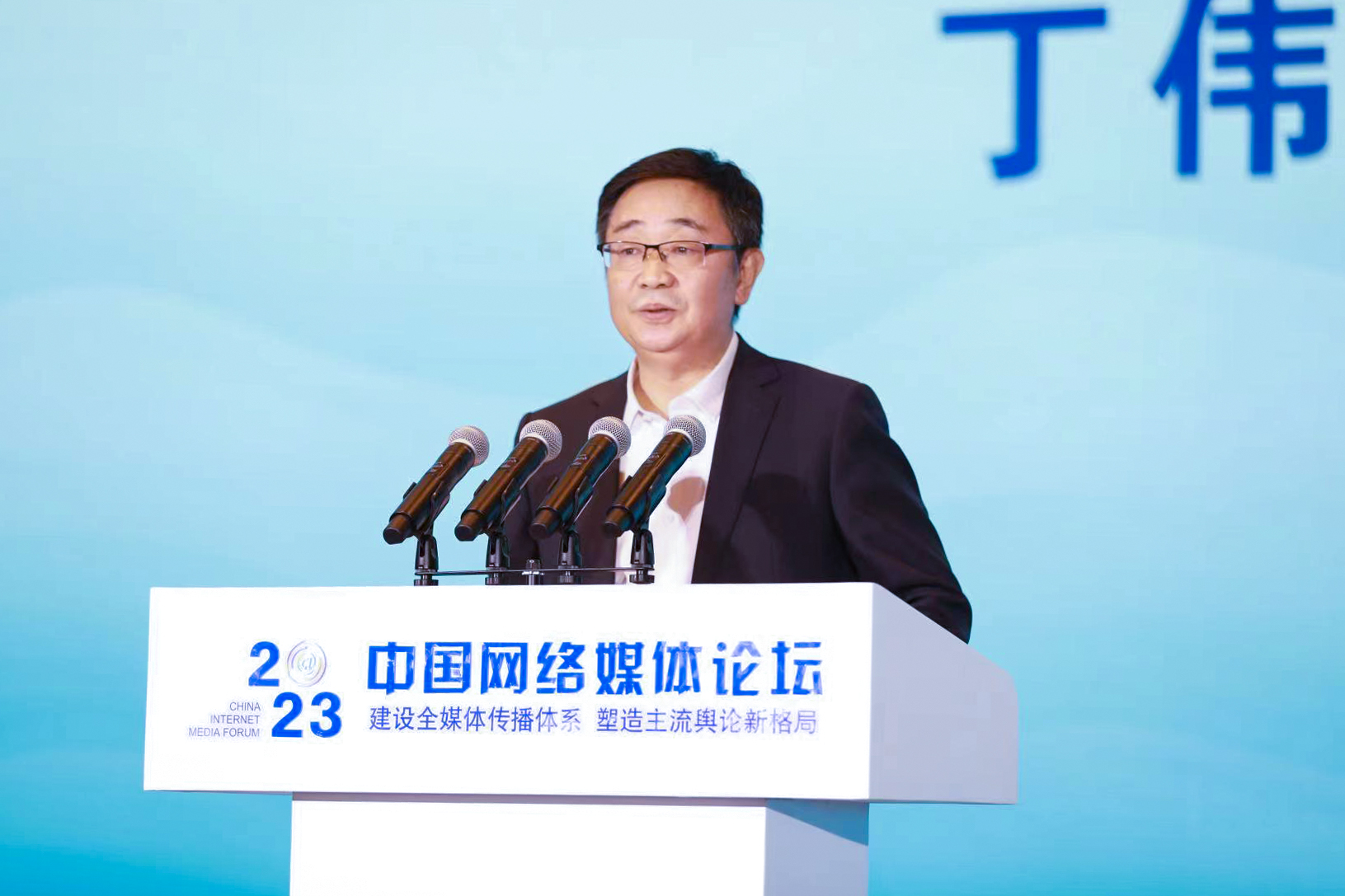
Ding Wei, director of the New Media Center of People’s Daily, delivered a keynote speech at the forum.
Ding Wei said that it has been 10 years since Weibo, the legal person of People’s Daily, went online in 2012. Standing at a new starting point, facing the rapid development of new technology and the profound evolution of communication mode and public opinion pattern, the sense of urgency is stronger than that of 10 years ago. Ding Wei talked about five dimensions of enhancing communication power in the all-media era, combining the new technology drive and the practice of People’s Daily’s new media.
First, adhere to the people as the center, rely on the people, unite the people, and be close to the people. Ding Wei said that adhering to the people-centered principle is a main thread that runs through the Supreme Leader’s Socialism with Chinese characteristics Thought in the new era, and it is also the only way to follow the mass line in the all-media era. A good public opinion field must be a public opinion field in which the party’s heart and people’s hearts resonate at the same frequency, and it must be a public opinion field in the same direction online and offline.
The second is to firmly build its own platform, open cooperation and create sharing, and achieve cohesion through aggregation. Ding Wei, taking the local articles of the People’s Daily video client "Vision" and "A New Thousand Miles of Rivers and Mountains" as examples, pointed out that the mainstream media should firmly develop and build their own platforms, constantly improve their original ability, and at the same time, vigorously improve their aggregation ability, transform from a simple content producer to an integrator, and realize the goal of "centralized" dissemination of mainstream values through "decentralization" in information production.
The third is to persist in promoting integration with technology and data drive, and move from "mobile+"to "smart+". In Ding Wei’s view, the mobile Internet is still the main channel for information dissemination, but it has become a fact that the mobile Internet is moving towards the intelligent Internet. Ding Wei said that the mainstream media should remain sensitive to new technologies, focus on the rapid application of new technologies in the era of smart Internet, constantly optimize user experience, enhance user stickiness and improve public opinion guidance. It is necessary to keep a close eye on the forefront of the Internet and realize the upgrade and integration of content production from readable to visible, static to dynamic, and one-dimensional to multi-dimensional.
Fourth, insist on gathering users with services, explore a new mode of "news+service", and constantly expand media boundaries. Ding Wei said that mainstream media should not only innovate in ideas, contents, forms, methods and means, but also continuously meet users’ growing demand for high-quality news information, and constantly expand media boundaries to create a new model of "news+service" media integration, provide more useful services in addition to providing information, ideas and emotional needs, and realize the deep connection between mainstream media and users by creating a "community of interests"
The fifth is to continue to expand the spread of scenes, open up online and offline, and provide better all-media inspection. At present, "all people are media, everything is media", and communication no longer relies solely on explicit communication carriers. Multiple communication subjects convey information, ideas and emotions in an indirect and flexible way, influencing users in a subtle way, and cross-border communication has become a new way to connect users and enhance communication effects. Ding Wei said that only when mainstream media find more valuable scenes to spread among a large number of emerging mobile scenes and intelligent scenes, get through online communication drainage and offline entertainment immersion, and provide appropriate information and services for specific scenes, can they accurately locate themselves in users’ minds and continuously enhance the communication effect.
Ding Wei also said that as the mainstream media, we should be brave enough to meet challenges and actively seize opportunities. In an era when information technology, communication pattern and public opinion ecology are constantly changing, we should uphold three "invariants" — — Do a good job in the initial intention of content, the determination to embrace technology, and the sincerity of serving users, and strive to build a new mainstream media to spread mainstream values more widely.